My Favourite Board Games

I’ve talked plenty about video games on this blog over the past few years, but I’m yet to dive into their analogue counterparts. The truth is, that’s mostly because I hadn’t played very many board games. I’d always been interested in them, and there have been a few that I’ve played a lot of, but it isn’t until the past 6 months or so where I truly understood the massive scope of what the genre could offer me.

Unfortunately, I chose to dive into this hobby during a time when the world has made playing games in a room with other people is exceedingly difficult. Nevertheless, I’ve picked up several new board games over recent months and have greatly enjoyed what they’ve offered me. I’ve even got enough now to make a list of my favourite board games…so let’s do that.

HONOURABLE MENTIONS:
XCOM: The Board Game, for it’s chaotic strategy
Talisman, for being weirdly calming and total bullshit in all the right ways
Blood on the Clocktower, which looks utterly brilliant, but I haven’t been able to play it yet

11 – Sheriff of Nottingham

One thing you’re going to realise throughout this list is that I enjoy lying in games. Whenever a game allows me to deceive my fellow players for my own ends, I jump at the chance to varying degrees of success. While a video game like Among Us is brilliant for something like that, nothing beats the rush that comes from looking someone directly in the eye, telling them a bald-faced lie and them believing you without question. Implications for what that could say about me aside, Sheriff of Nottingham is one of several games on this list that provide such opportunities.

The premise is quite simple, each player takes turns being the Sheriff, and everyone else are traders trying to get their goods into Nottingham to sell them at the market. Each player fills their hand with up to six cards of different types of good; some are simple stuff like bread & cheese, while others are contraband items like crossbows or silk. Each trader puts their cards into these little bags and hands them over to the Sheriff. The Sheriff then asks the trader what’s in the bag, and the trader must declare how many goods they have and what they are.

Here’s where the fun lying stuff starts. You can only declare one type of good at a time, and you can’t declare contraband, so you’ve got to seem as innocent as possible while you declare. The Sheriff can decide if they believe you or not, and if they don’t, they open the bag. If the Sheriff was right to not believe you, you have to pay a penalty; however, if the Sheriff was wrong, they pay YOU a penalty. Already, this creates a great push & pull between the risk and reward factors of opening the bags, but it goes one level deeper.

The thing is, before the Sheriff opens your bag, you can offer bribes or trade deals to let your goods through, including items that you claim are in your bag. In this section here there’s so much manipulation & bluffing that can go on. You could offer the Sheriff an item that isn’t actually in your bag, tricking him into letting your stuff through for free. You could promise the Sheriff to do you a favour when it’s your turn to be Sheriff. You could even go full quadruple bluff and offer the Sheriff a bribe even if you’re entirely telling the truth, just to try and lure the Sheriff into opening the bag and paying you a bunch of cash.

It’s layer upon layer of bluffing and deception as you try to build up a trading empire, trying to make everyone on the board work to your favour, whether they realise it or not.

10 – Anomia

A much simpler game now, but one that feels so much more chaotic when you play it.

Named after the sensation of forgetting straightforward information under pressure, Anomia makes you draw cards, each of these cards has a symbol on them and a basic category like ‘vegetable’ or ‘football player’. Everyone takes it in turns to draw a card from the deck and place it face-up on their pile. If your face-up card matches the symbol of some else’s face-up card, you both have to name an item/place/person from the category on the other person’s card. The fastest to do so gets all the opponent’s card. It goes until the deck runs out of cards, and whoever has the most wins.

It may sound like it can’t be all that fun, but it really is a frantic sensation when you suddenly realise a symbol matches and, under pressure, you suddenly find you can’t think of a single type of currency to name, so you instinctively just yell the word ‘money’ to raucous laughter from the table. It gets even more chaotic, though, because when you lose a card, the next card on your pile becomes visible, and if that happens to match someone else’s face-up card, then you have to immediately go again. This can snowball in some hilarious ways with long chains of cards flying all over the pace as people frantically try to think of the most simple information but hilariously fail under the pressure.

It’s a game that sometimes makes you feel stupid, but A) it’s hilarious, and B) it happens to everyone on the table at some point, so it never feels like anyone’s being mean to anyone else. It also has the benefit of being a game simple enough for people to understand while drunk, where the slower reaction times and warped mindsets can enhance the chaos in the best ways.

9 – Spyfall

Back to the lying!

Spyfall takes the interesting formula of the long-form social deduction games like Sherrif of Nottingham & Werewolf and condenses it into a 7-10 minute game that gets surprisingly tense as the clock ticks down.

The premise is simple, you have 4-10 players, and one of those players is a Spy. All non-spy players are given the same location card, but the spy doesn’t get that information. Players then take turns to ask each other questions about the location to try and work out who’s the spy. So, for example, if you’re at the beach, you might ask, “How hot is it here?” to see if they know that you’re at a typically hot location. However, you can’t go all out because, at any point, the spy can take a guess at where the location is, and if they’re right, they win the game. This creates this brilliant dilemma, where players have to ask questions and give answers that are vague enough to not give away the location but also not so vague that people are suspicious.

The ticking timer format puts pressure on the non-spy players to ask questions that risk tipping their hand to a spy who’s on the ball to get as much information as quickly as possible, and it can lead to some last-minute clutch accusations. It takes the wide and loud debating of other social deduction games but limits it by turning the game into a more quickfire affair. It also forces you to come up with creative questions to root people out. For example, if the location is a Space Station, you could ask someone, “How was your trip to work this morning?” in a question that would be an obvious trap to anyone who knew the location but totally baffles a spy.

On top of that, it can be really funny to hear people describe locations while still trying to be vague. The awkward wording that people come out with as you can see their faces contorting as they rack their brains for the right word is beautiful in a way. What’s more, is each card will give people a job for that location which they can roleplay, such as the janitor or the pilot, which is great if you’ve got people in your gaming group who thrive at those kinds of things while giving unsure players a bit of a more solid footing to answer and ask their questions.

It’s a fast, funny game that you can happily play round after round of because of it’s simple nature, which also helps it be a good introduction for people to social deduction games.

8 – Wavelength

Wavelength is like if a game of ‘guess what I’m thinking’ told you way more about how your friends think than you were expecting.

Best played in teams, Wavelength involves a dial and a series of cards with different topics. One player from one team will spin the dial and see where the wedge of points are on the dial. This then gets hidden, and they draw a card with a scale on it. Some of these are fairly simple concepts like ‘hot to cold’, but some are more subjective, like ‘good film to bad film’. The player who saw where the points were on the dial then has to give a simple clue to help the other members of their team guess where the points are.

For example, if the points were all the way at the ‘hot’ end of the dial, the clue might be ‘the sun’, or all the way at the cold side would be ‘the arctic’. However, what if it’s only 75% of the way over to the ‘hot’ side? What clue do you give then? What could you say that will make your teammates put the dial only half-way to the ‘hot’ side? You could say something like ‘tea’ which is traditionally a hot drink, but it’s nowhere near as hot as the sun, so would they put the dial far enough? And what about iced tea? That’s pretty cold.

It creates this fascinating scenario of two sets of people trying to guess how the other one thinks, and people inevitably end up over-analysing and thinking too hard about it, which is always pretty funny to watch. This gets even better with the more subjective cards, as you argue over whether or not your friend enjoyed The Dark Knight Rises or hated it, or maybe thought it was somewhere in the middle? It can lead to some amusing arguments and interesting discussions over where to place things, and you end up learning things about the people you play with as well, making it a fantastic ice-breaker game.

7 – Obscurio

Obscurio is a game for those who like theatrics and atmosphere from their board games.

The premise of Obscurio is that a bunch of wizards are trying to escape a tower, and on each floor, each door is marked with a piece of art, with only one being correct. In order to work out the correct door, they seek the help of a friendly ghost, who is only allowed to communicate with the wizards via other pieces of art. The ghost will look at the correct art piece and use two other art pieces to give the wizards clues. The challenge comes from how these clues can be left open to interpretation.

For example, let’s say the correct door is a painting of a beach. The ghost could use one of the little pointers to point to the sand in an hourglass on a different art piece. However, will the wizards interpret it that way? Or will they instead think it has something to do with time, so maybe it’s the art of the grandfather clock? To add an extra layer of complexity to the mix, one of the wizards is actually a traitor, who got to pick the art for one of the incorrect doors to try and fit the clues the ghost has given.

Mechanically, it’s an enjoyable game, but what puts it over the top of similar games is the atmosphere and aesthetic is creates. The art discs that represent the doors are beautiful pieces, and all of the components fit this feeling of mysterious magic & supernatural phenomena. It creates a brilliant opportunity for the people who love the theatrical side of board gaming, as you lower lights and close your eyes while the player who is the ghost silently glides around and sets up their mysterious clues.

6 – Taskmaster: The Board Game
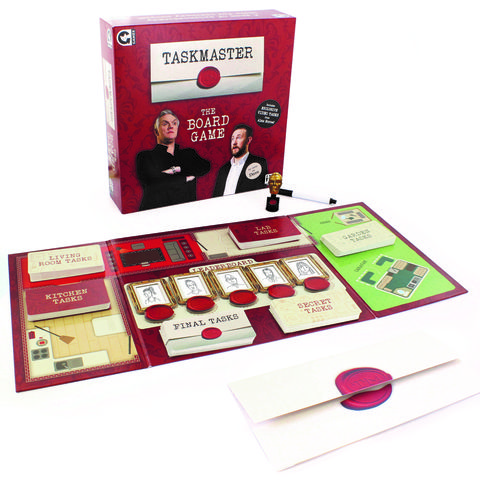
I’ve talked about it before on this blog, but I love Taskmaster. I think it’s a genius format and one of the funniest shows on TV right now. The board game takes what that show is about and adapts it for a homely, low-budget environment, and it really seems to understand the format it’s in. I think that’s worth giving special praise for, too, so many board games based on popular shows don’t really get the format they’re in and just rely on the name-brand to do all of the work, but The Taskmaster Board Game feels like it understands the best way to play Taskmaster in your home.

Firstly, it doesn’t add any frills. It doesn’t create some board that you have to hop around and only do tasks when you land on the right space or something like that; it knows that the tasks are what you’re here for, so it just lets you go with it. Several of the tasks can be transferred over from the show with no problem, while others are adapted to be on a smaller scale, but they’re all still fun to play. On top of that, there’s genuinely loads. While it may get a bit repetitive if you played it too much, there are so many tasks in there (and hundreds more all over the internet) that it’ll be a long time before you run out.

Letting everyone take turns fulfilling the role of Taskmaster was a good idea as it means everyone gets a variety of participating & running the tasks in a single game. I love how the rules specify that the Taskmaster is completely allowed to make dumb or arbitrary decision if they want to. That lack of restrictions not only apes the show, but it gives so many opportunities for laughs between players.

That’s really all this game has to it, having a laugh with friends as you all take turns humiliating yourselves. Which, let’s be honest, is what Taskmaster is all about.

5 – Superfight

So I don’t like Cards Against Humanity. I’m all for the dark humour (even if some of it hasn’t aged so well), I just don’t think there’s all that much fun to be had in assigning pre-written punchlines to pre-written jokes, and once the shock factor of the dark humour wears off, there’s really nothing under there.

Why does this matter? Because Superfight takes what Card Against Humanity does and fixes those problems I mentioned.

Two decks of cards are laid on the table, one with characters from all aspects of pop-culture and another of superpowers that range from your standard stuff like flight/telekinesis to some silly stuff like ‘is killed by water’ or ‘is on a pogo stick’. From here, there are a handful of different ways of playing the game, but the one I’ve most commonly seen (and think is the most fun) is as follows:

One player at the table will be the supervillain. They play a character card & a superpower card from their hand and then draw & play a random superpower from the deck. Each player then takes turns playing one character & one superpower card that they think would beat the supervillain. At this point, the game becomes a debate of ‘who would win in a fight between…?’ but with many ridiculous scenarios like 50 Batmen VS Pikachu inside a giant robotic elephant or whatever.

What makes this so much funnier that something like Cards Against Humanity is that the cards simply act as a launching pad for the players to make their own humour. The debate surrounding exactly how 50 Batmen could disable a giant robotic elephant and then beat up Pikachu always leads to hilarious scenarios, especially when other players argue back. You can make it even funnier by allowing players to play extra superpower cards on other people, potentially crippling an otherwise worthy opponent by making it so that they’re uncontrollably weeping.

Rather than the cards serving as the jokes, it allows the players to be creative and play to their audience. You could never play Cards Against Humanity with your grandparents, but with Superfight, you can just keep it clean. There are other DLC decks that let you tailor the game to your audience, with kid-friendly stuff or R-Rated stuff. It makes it a far more versatile game and is way more hilarious when you’re making original jokes with people you know.

4 – Skull
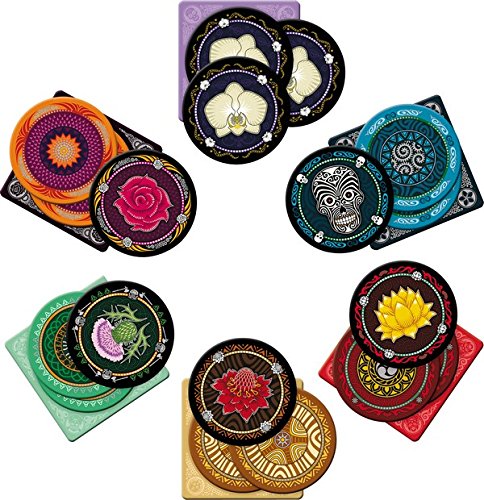
I love traditional playing-card games. Games like Poker and Cribbage have an outstanding balance of playing the odds and reading your opponents to create an endless amount of exciting scenarios that really get the brain whirring. Skull takes the essence of those games, simplifies, beautifies, and repurposes the formula for something that feels so fresh yet so familiar.

In Skull, 3 to 6 players each get 4 cards. 3 of these cards have flowers, and 1 of them has a skull. Each player picks one of these cards to place face-down in front of them, then each player takes their turn. On their turn, a player can either put another card face-down or start the ‘bidding’ process. Here, a player says how many cards they think they can turn over WITHOUT turning over a skull. All of the other players can either raise this bet or pass until only one person has a bet left in play. That player then turns over people’s cards in an attempt to reach their target.

This already gives the game a nice layer of bluffing about who’s cards might be safe, but there’s a small twist that adds so much strategy to the game. This twist is that when you start turning cards, you have to turn over all of your own cards first. This means that if you’ve put a skull down to try and bluff someone or screw someone else over, you’re done for. This means that you have to avoid putting a skull down to win rounds, but doing so also leaves the door open for others to score by turning over your cards.

It’s a simple enough formula that just about anyone can understand, but your thought processes can get so deep as you decide whether or not to put a skull down, or who’s cards you think are safe, or whether it’s time to start betting. It’s the board game that I think best captures the essence of what those play-card games I love are all about.

3 – Muffin Time

Who doesn’t love a bit of chaos? Well, most board-game enthusiasts, it seems, but sod it, I love a game full of random bullshit.

I’ve always had a love for the asdfmovie series on YouTube, and all of Tomska’s work, in fact, so I was on board with the premise of a card game based on the franchise from the very beginning especially one by Big Potato Games. While I haven’t featured many of their games on this list, when it comes to party games, you’d be hard-pressed to find any company with an output of such consistently high quality.

In Muffin Time, you start off with 3 cards, and your goal is to get 10 cards. On your turn, you either draw a card from the deck, lay a trap card, or play an action card. That’s it. It’s an insanely simple game, but what’s on those cards is where the fun comes in. Firstly, there are action cards, which have all sorts of conditions on them. Some start a minigame, like a thumb war or finger guns. Others say things like “steal 3 cards from the tallest player”. Basically, it’ll either benefit/hinder people, based on aspects of them, or it’ll have a fun little minigame.

The real fun stuff comes in the trap cards, though. These are cards that you lay face down on the table and ‘activate’ when someone in the game does a specific action. For example, you could get a trap card that lets you steal 3 cards from someone when they ask what the time is, or when they say a specific phrase, or talk about something from the past. What this means is that everyone on the table is constantly trying to bait each other into doing or saying certain things, and because of that, everyone has their guard up, and everyone is suspicious of everyone at all times. It’s unbelievably fun and incredibly funny when you perform a seemingly ordinary action only for someone to go “AH-HA!” and turn over a card that fucks you over because you said the word “what”.

The nature of it means it works in many different contexts too. You can play it with a group of friends your own age, or you can play it with the family, and it’ll still be a fun experience because it’s so easy to understand and the humour is very simple. It’s one of the rare examples of a game that’s “fun for all the family” that isn’t boring for anyone who’s age has more than one digit.

2 – Cosmic Encounter

There’s so much going on with Cosmic Encounter, and it’s ALL brilliant.

It’s the most rules-heavy game on this list, so I won’t go through all of it, but in short: Each player has some planets they call home and a fleet of spaceships defending them. Players take it in turns attacking each other’s planets to take over as many foreign planets as possible. The system all of this works under is like Risk, but better in just about every way because there’s no random elements, a bunch of potential of poker-style bluffing and a hefty dose of strategy.

This on its own is already a fantastic strategy game, but, as always, there’s a twist. While the game has these very robust rules laid out that have been honed over the game’s VERY long lifespan, each player has their own alien race to play as. These alien races all have their own unique abilities, but it’s not like in other games with player bonuses. The bonuses in this game aren’t just little helping hands that push you down one type of strategy, they’re ridiculously overpowered abilities that totally break one or more of the game’s rules. Now, this does seem a bit unfair (and sometimes it is) until you consider the fact that every player in the game has their own game-breaking power.

These powers can combo up in insane ways to create some mind-bending but hilarious scenarios. For example, one player might have the power to reverse the decision of a battle before the battle takes place, so if they think they’re going to get destroyed, they can turn into a win. However, the player they’re fighting against will WIN THE ENTIRE GAME if all of their ships are destroyed, which means they’re going to be trying to lose the fight. Except, the second player knows what the first player’s power is, so maybe they’re trying to win the battle in the hopes that the first player will reverse the decision? WHAT DOES ANYONE DO?!

That’s just one of a near-infinite amount of ways these powers could combine in games, and all of them have been carefully crafted and honed over many years. It has tonnes of replayability, too, with 51 different aliens in the base game and 196 aliens if you get all of the expansions. No game will have you scratching your head so hard while laughing even harder in a truly masterful blend of chaos and strategy.

1 – Secret Hitler

I said it at the start, and I’ll say it again now, I enjoy lying in games. Social Deduction is inarguably my favourite genre of board game, and while upcoming games like Blood on the Clocktower look very interesting, to date, nothing has beaten Secret Hitler as far as I’m concerned.

At the start of the game, everyone gets given their secret roles. Players are split into two teams, ‘Liberals’ who are the good guys and the ‘Fascists’ who are the bad guys. One player will also be ‘Hitler’, who is on the team of the Fascists (duh). The Fascists know who their allies are, the Liberals do not. Each player takes a turn being the ‘President’, and they must pick one other player to their ‘Chancellor’. They then draw 3 policies, which will either be Liberal or Fascist in nature. The President discards 1 policy and hands the remaining 2 to the Chancellor, who then discards 1 more and plays the remaining policy.

Here, the debate begins depending on which team the policy that was played came down for. Liberals need to enact 5 Liberal policies to win the game, the Fascists need 6, but the deck is weighted in favour of the Fascists, with 11 of the 17 policies in the deck being Fascist. On top of that, the more Fascist policies that get enacted, the more powers get unlocked for players to use. This means that even the Liberal players have an incentive to play Fascists policies, as they can be instrumental in uncovering the Fascists or even getting the ability to kill players, which, if done to Hitler, will win the game for the Liberals.

There are so many interlocking strategies here, but since none of the Liberals know who their allies are, they can communicate a plan to anyone until they trust them; and even when you do trust them, they could just be playing you. As you can imagine, this is a game filled to the brim with lies, betrayals, risks, rewards and failures, and all of it is an absolute blast. This is the game that I have the most fond memories of, as I’ve played it at several different stages in my life, and there’s never been a bad game.

Nothing brings friends together like loudly arguing with each other over who’s Hitler.

And that’s it! Thank you very much for taking the time to read this list, please, let me know what your favourite board games are in the comments below, or let me know on Twitter @SStyleSmark. Finally, make sure to come back here this time next Saturday, where I’ll be covering AEW Revolution!

Best Post-Game Features in Pokemon Games

When it comes to determining my favourite Pokemon games, one of the biggest considerations is how much there is to do in the post-game. For those unaware, the post-game is any features/stories that become available to you only after you have seen the game’s credits roll for the first time. In Pokemon games, this translates to anything that happens after you’ve defeated the champion and entered the hall of fame.

These are the features that keep you playing hours after having finished the game and provide a handful of extra challenges to prove your team’s mastery. To be clear here, I’m not talking about the general stuff that you can do in every Pokemon game, such as shiny hunting or competitive battling, I’m talking about the unique stuff that only features in one or two games. I also won’t cover the Isle of Armor or the Crown Tundra, as those are DLCs you have to pay extra for.

8 – Ultra Wormholes – Ultra Sun/Ultra Moon

It’s become standard fare in the modern era of Pokemon for at least one game in every generation to include all of the legendary Pokemon from previous generations for us to catch and encounter. This has led to a few fun systems. The Dynamax Adventures in Sword/Shield are a lot of fun, but I struggle to call them post-game, since they’re a huge feature in the Crown Tundra DLC, and the ‘soaring’ mechanic in Omega Ruby & Alpha Sapphire filled that purpose well too, but I think this was the best it has been done.

Once you switch the control method away from motion controls, the mini-game through which you find all of these Pokemon is a lot of fun. It only takes a couple of minutes every time, and it provides a little bit of challenge to get to the Pokemon you want, rather than just fulfilling certain requirements. On top of that, you had to look for the different coloured portals to find the right Pokemon, and even if you didn’t encounter a legendary, you could find plenty of other Pokemon with boosted shiny odds, so it was a win-win, really.

The little environments made good use of the multi-verse concept those games focused around, with each of the Ultra Beasts’ domains being especially beautiful and fun to explore. As a shiny hunter, I spent a lot of time using this feature in USUM, and I’m glad it was a lot of fun to do so.

7 – The Battle Zone – Diamond/Pearl/Platinum

To be clear, I am not including the Battle Frontier in this bit, I’ll talk more about that later, I’m referring to the island as a whole that you get to explore after becoming champion in the Sinnoh games.

For starters, as soon as you get there, you have a double battle with the final Gym leader and an Elite Four member, which is pretty cool and after that, you’ve got a whole island to explore. It features three whole towns, each with their own unique features, a massive villa that you can own and furnish, a whole host of Pokemon not in the Sinnoh-dex, a cafe where you can rematch Gym leaders, and a god-damned Volcano where you can fight Heatran.

What I love so much about this island is how completely different it feels to the rest of Sinnoh. Even the ground is a different colour here, playing off of the volcanic/tropical island vibes to great effect. The routes are winding and dangerous, just like you’d hope them to be at such a late stage in the game, with one final dungeon for you to explore in the form of Stark Mountain. The music is pretty kick-ass too.

It’s just so cool to have a bunch of new areas to explore after you think you’re done with the game, even if nothing major happens around those places in the grand scheme of thing.

Speaking of…

6 – The Rest of Unova – Black 2/White 2

In the original Black & White games, the post-game allowed to explore a new portion of the map. It was ok, but ultimately didn’t really hold anything special outside of a few non-Unovan Pokemon and the Kyurem battle. However, the direct sequels had a lot more to offer on that front.

In Black 2 & White 2, you start the game in a completely new area of the map, with some brand new cities to explore, but that means you completely skip all of the starting towns from the original, including two of the gyms. They still sit there on the map though, taunting you as to the possibilities of what you could find there, so when you’re finally let loose to explore it in the post-game, there’s a lot of fun to be had.

Much like the Battle Zone, it provides you with a bunch of new areas to explore, only these areas are filled with a bunch of nostalgia from the original Black & White games. You get to explore fully fleshed-out towns from the originals and encounter a load of new content there. It’s a wonderful blast from the past if you played the originals and a great series of places to explore for the first time if you didn’t.

5 – The Pokemon World Tournament – Black 2/White 2

Let’s see what we have here…a bunch of trainers from old games? Check. Every old Gym leader? Check. Every old Elite Four member? Check. Every old Champion? Check! What more could you possibly ask for?

It’s a huge blast of nostalgia, but that’s exactly what I want from a post-game battle facility like this. It pulls in everyone from all the old games and celebrates the contributions they made to their games. We get remixed themes, improved and remixed teams, and the game celebrates them like the heroes they are to those of us who have played the old games. It’s wonderful to see the Pokemon games happily throw caution to the wind and just let you have a bit of everything for the ultimate tournament experience.

On top of that, it’s genuinely challenging. The battles I had in the champions’ tournament are genuinely some of the most challenging singleplayer battles I’ve ever faced in the series. This is an area that has absolutely no desire to hold back and throws the best of what it has to offer at you in an attempt to earn the ultimate victory. In an era of Pokemon where the lack of difficulty is one of the main complaints about the franchise, it’s really great to go back and remember some of the times where the franchise gave you absolutely no mercy.

We’re three full generations removed from this world tournament, and honestly, I want to see it happen again. Sword & Shield didn’t shy away from using tournaments in its climactic battles, so having another situation where trainers come from around the world to compete in an ultimate tournament would be amazing. Stuff it to the brim with as many trainers as possible to make it feel like a proper Pokemon league, and it may just skyrocket to the top of lists like these.

4 – The Battle Frontier – Platinum

That’s right, I’m putting my cards on the table. Platinum’s Battle Frontier is better than Emerald’s, it just is, ok?

The post-game battle facilities haven’t been all that great in the modern generations. The Battle Tree is fun when it comes to seeing old trainers, but that’s about all it does differently. Meanwhile, X/Y and Sword/Shield did the bare minimum with the Battle Chatuex and Battle Tower respectively. They present a nice challenge if that’s what you want from your post-game in Pokemon, but personally, it’s not what I get drawn towards.

That’s what makes the Battle Frontier so special to me because it makes those post-game challenging battles more fun by adding a whole heap of gimmicks on top. You’ve got the Battle Tower, which is your standard streaks of battles, which is fine enough, but the other facilities are where the real fun lies. The Battle Castle puts a minor twist on the usual formula by not healing your Pokemon between battles, instead giving you currency and forcing you to make some tough choices as to how you how/what you want to recover between battles.

The other facilities get progressively more wild and fun though, you have the best battle facility from Emerald making its reappearance in the form of the Battle Factory. True to Dynamax Adventures in Sword/Shield, using rental Pokemon can be a lot of fun and cause you to use Pokemon you would have never otherwise considered to some great results. Then there’s the Battle Hall, where you have 1 on 1 battles against Pokemon that are a type of your choice. This is fantastic, as it’ll force you to consider unconventional strategies to take down Pokemon of types your Pokemon is very weak against as you wipe the floor with everyone in sight.

Finally, there’s the Battle Arcade, where every battle rolls random effects. Some will help you, some will utterly destroy you. It’s random, stupid and sometimes ridiculously unfair, but that’s honestly why it’s my favourite facility. It’s unpredictable and wild as to what will happen, and I have so much fun trying to work my way out of corners the randomizer forced me into.

This version of the Battle Frontier injects fun gimmicks in the post-game battles that really keep things interesting, and there’s enough variety in how they operate, that there’s likely to be something for everyone within its walls.

3 – Team Rainbow Rocket – Ultra Sun/Ultra Moon

Yes, this was just an excuse for Game Freak to bottle nostalgia and sell it back to us and I don’t care, because it’s cool as hell.

From the moment I saw that ridiculously cool piece of promo art, I knew I was in for a treat when it came to the US/UM postgame, and I was not disappointed. Team Rocket show up out of nowhere, and not only do they have a renewed sense of threat to them, but they’ve also got an updated battle theme that holds the essence of the original and makes it cooler than ever before. That rock version of the Rocket battle theme is just too good to not point out.

Then, you head to Aether Paradise, and all of that juicy nostalgia hits you in the face. First of all, you go through a bunch of puzzle rooms that mimic the old style of evil-team bases. There are teleport puzzles, arrow trap puzzles and just about everything you could want. Then, there are the actual team leaders themselves, except these are the versions of them that didn’t lose to a 10-year-old kid and actually succeeded in destroying/altering/ruling/creating a whole new world.

You face these leaders with a strong sense of their ideals as they give you a small glimpse into the world they created, and you get to fight some buffed-up teams of theirs for some epic battles. In here, it’s the little touches that make these battles so much fun, like the fact that they’ve all caught their Pokemon Master Balls or the INCREDIBLE remixed battle-themes. Cyrus & Lysandre’s especially are some of my favourite pieces of music in the whole franchise.

Then you face off with Giovanni, who seems like a genuine threat for the first…well, ever, to be entirely honest with you, as he attempts to rule the multiverse, whatever that means. He too gets a kick-ass battle theme and a strong team of Pokemon that will really put you to the test if you didn’t adequately prepare.

To put it simply, it was just so much fun to experience all this nostalgia in one lovely digestible sequence of events. Facing the old leaders, seeing them all team up and getting to fight them all off in an epic series of encounters. Is it a bit over-the-top and childish? Absolutely. Do I care? Not in the slightest.

2 – Delta Episode – Omega Ruby/Alpha Sapphie

A handful of Pokemon games have held over narrative elements into the post-game. There was the 7 sages in Black & White, or the Heatran stuff from the Sinnoh games, for example, but until the Delta Episode, it had never been done to this extent.

When Zinnia showed up following the credits of ORAS, there was a lot of intrigue to be had. Not only was this something we’d never seen in a Pokemon game before, but it completely diverged from the story of the original Ruby/Sapphire/Emerald games, of which these were a remake. It wasn’t some massively epic story or anything, but I like how it gave you a quick mystery, hit you with a pretty significant threat and then immediately sent you off to the tower. Here, you learn a bit more about the lore of Groudon, Kyogre & Rayquaza, and there’s that slow realisation of where this is going.

Additionally, this was the first time Pokemon actually addressed the possibility of a multiverse, something Generation 7 would play around with a lot in its narrative. What really blew me away were the two major reveals that happened during this sequence. I have no idea if these were revealed before the launch of the game, but when I played through them for the first time, I had no idea that 1) Rayquaza was not only catchable in the game but had a mega-evolution that is honestly one of the cooler ones out there and 2) You got to catch DEOXYS of all Pokemon, which was an incredibly cool and memorable moment when I experienced it for the first time. As the Crown Tundra has proved, Pokemon games seem to be becoming more willing to make Mythical Pokemon available as an occasional treat, and it gives me high hopes if the Sinnoh remakes are ever produced.

While I don’t think we’ll see this kind of thing super often anymore, as the franchise has moved on to more fully-formed DLCs instead, but either way, this was a very memorable experience that held a nice couple of surprised following the ORAS credits.

1 – Kanto – Gold/Silver/HeartGold/SoulSilver

It’s an obvious choice, I know, but what else could it possibly be? Sure, some of the other entries on this list might hold more interesting aspects or flashier ideas, but this a WHOLE REGION for you to explore, including an extra 8 gym battles. This is the stuff we can only dream of in the modern era of Pokemon.

I experienced the Johto games for the first time in the form of the remakes, HeartGold & SoulSilver, which are absolutely incredible games in their own right. Once I’d finally fought through to defeat the Elite 4, to be told that there was now a whole new region for me to conquer was terrific. More to that, since this was only the second Pokemon game I’d ever played (first was Platinum), I’d never seen Kanto before, which meant all of it was brand new to me. It was like an extra Pokemon game on top of my Pokemon game.

Even if you had already played through a Kanto game, there was still huge value to be found in exploring the region a few years following the events of the original games. There’s great fun to be had in seeing how the gyms had changed and who was leading them. After battling Koga in the Johto Elite 4, you find out that his daughter has taken over his Gym, you find out that your former rival took Giovanni’s place as the final Gym leader. It’s got the right balance you want from a ‘sequel’ of the region, with a bunch of nostalgic elements, with a feeling of progression.

Then, once you’ve done all of that, you get to go to Mount Silver and have what is still, to this day, one of my favourite battles in the entire franchise against Red with some ridiculously high-levelled Pokemon for the standard singleplayer experience. Given that Gold & Silver were originally designed to be the last games in the franchise, they definitely nailed the feeling of wrapping everything up from the first two generations, and the exploration into Kanto was a huge part of that.

So there you have it! Thank you very much for taking the time to read this post, please let me know what you thought of Pokemon post-game features, either in the comments below or on Twitter @SStyleSmark. Make sure to come back here this time next week, where I’ll be covering my favourite Fall Guys levels.
AND don’t forget to come and check out my streams at https://www.twitch.tv/strongstylesmark 2pm GMT Tuesdays & Thursdays, and 6pm GMT on Saturdays!

Game of the Year 2020

We’re here! The year is finally coming to a close! As we all sit and pray that 2021 won’t somehow be worse than 2020, it’s time to wrap things up with a look back at the games released over the last 12 months and see what we enjoyed the most.

First, some caveats. I HAVEN’T PLAYED CYBERPUNK 2077. I do want to play it, and I am going to in the new year, but it became apparent to me that even if I did play it on launch day, I wouldn’t have been able to play enough of it in time to fairly judge how much I liked it. So, I’m not writing it off, but expect to see it appear on my 2021 ends of year lists rather than here. Secondly, I don’t own a PS5 or an Xbox Series X, so if a game was exclusive to either of those consoles, then I haven’t played it.

I will also be continuing to add the games I think are worthy into my 100 Favourite Games list, so check that out too, if you want context on that one.

Outside of that, though, I’ve played quite a wide range of games this year. I don’t know if I played quite as many as in 2019, but that’s more because there have been fewer games coming out. As such, this list will cover quite a variety of stuff, and I won’t waste any more time rambling. Let’s look at the best of what this year had to offer!

SPOILER WARNING!

While I’ll try to avoid anything too plot-critical, I will be talking about spoilers for all of these games. I’d recommend you tread carefully with games you like the sound of, especially as some of these are heavily narrative-focused games.

14 – Cloudpunk

Release Date: 23rd April
Developer: Ion Lands
Publisher: Maple Whispering Limited
Platforms: PlayStation 4, Xbox One, Nintendo Switch, Windows

I didn’t know how to feel about Cloudpunk for quite a long time, but after thinking it over, I definitely think it deserves to be discussed on this list.

Cloudpunk is a game with an incredible atmosphere. The sound design team did an absolutely incredible job of creating the feel of the kind of city Cloudpunk is set in. The whirring of the cars, the low rumble of chatter in the street and the miserable atmosphere the whole thing carries with it. Even the music the in-game radio gives you has such a ‘manufactured’ feel to it which is perfect for the tone the game is trying to convey.

On top of that, it’s a master of the ‘show, don’t tell’ philosophy. Your job as a courier (and occasional taxi driver) around the city means that you really get to see every aspect of the place. From the dark, dank depths on the underbelly to the more well-off areas, and the people that live in them. You start in an unfamiliar land with unfamiliar people, but as the game progresses you really grow to feel a sense of attachment to the city and many of its citizens, and you see all sides of it.

The game doesn’t shy away from giving you the moral choices either. It dumps a pretty heavy one on you reasonably early, and they keep on coming from there. It’s not the perfect dynamic system of something like Papers, Please, but it’s more than enough for what the game is trying to do.

So this may pose the question, why did I not know how to feel about it? The simple answer is that the ending wasn’t what I was hoping it would be. That’s not to say it was bad, but I definitely think a lot more could’ve been done with it and I almost wish they’d made it a little longer to properly dig into some of the ideas it touched on. However, I’ve also spoken to people who loved the ending and thought it was perfect, so you’ll have to make up your own mind on that one.

Even if I did feel it ended on a low note, the world and narrative throughout have still stuck with me all these months after I first played it, and that definitely makes it deserving of a spot on this list.

13 – Spiritfarer

Release Date: 18th August
Developer: Thunder Lotus Games
Publisher: Thunder Lotus Games
Platforms: PlayStation 4, Xbox One, Nintendo Switch, Windows, Mac, Linux, Google Stadia

There’s a lot to unpack when it comes to Spiritfarer. In terms of gameplay, it takes elements from a lot of different genres. On the face of it, that sounds like a bad thing, but in actuality, the game takes just the right amount from each genre and balances them incredibly well.

The first thing that struck me when I started playing was how beautiful it’s visual/animation style was. Everything looks so wonderfully vibrant and colourful, and every character moves and acts in such adorable ways. It puts me in mind of some of the old Hanna-Barbera cartoons with how much life the animations bring to the characters and the world. Similarly, the sound design is a huge plus. The sounds of the ocean and the slow creaking of your boat are very relaxing sounds to listen to, and when music comes into play, it wraps itself around you and pulls you right into the moment.

The survival/crafting elements that drive the largest portion of the game are great. The process of collecting/manufacturing resources is never a chore and done at just the right pace so that you don’t breeze through it all and get bored. What’s great is that all of the main character quests will take you to the places you need to find the new resources, so you’re always progressing at the perfect pace for where the game wants you to be.

Similarly, the world is a joy to explore. The game limits the areas you can explore in just the right way so that you don’t get too overwhelmed or stray off of the beaten path until you’re ready to. Even at the start of the game, when you’re the most restricted, there’s still a huge amount of areas and oceans to explore, and you never lose that sense of discovery. Additionally, travelling from place to place is never a chore. There’s always something to be doing to keep you occupied as your boat sails from one place to another. Some farm will need watering/picking, or food will need cooking, or ores will need smelting, and even if you’ve done all of that, you can always fish for more food.

What drives this game at its very core though, is the spirits which travel with you along the way. Your job as the spiritfarer is to see spirits through their last business in the world, before taking them to the gateway to the afterlife, and no matter how many times you have to do it, it’s still an emotional moment. You get to see the lives of spirits laid out before you and understand what they’re truly like, only to have to eventually say goodbye and move on to the other spirits you need your help. To describe the kind of feelings it evokes is difficult, but if you’ve ever experienced grief, then you’ll definitely relate to the feelings on display here.

Place on 100 Favourite Games List: 95

12 – Star Renegades

Release Date: 8th September
Developer: Massive Damage
Publisher: Raw Fury
Platforms: PlayStation 4, Xbox Series X/S, Xbox One, Nintendo Switch, Windows, Mac, Linux

Arguably the most obscure game on my list this year, Star Renegades mixes the roguelike & turn-based strategy genre in a way that I haven’t seen since Into the Breach.

What I love about turn-based strategy (TBS) is the feeling of sitting down and working out a really good plan, whether that plan works or fails miserably is beside the point. In a TBS, I see each battle as a puzzle to be solved, and it’s the thinking through the possibilities that brings me the most joy. Star Renegades is brilliant at tapping into that part of me.

The battle system comes together in the kind of way I absolutely adore. The fact is, you could technically go through any battle without taking a single hit if you’re good enough, but the game makes sure to keep applying the pressure to make sure you never get too good. It takes ideas from D&D in that each ‘turn’ is 60 seconds of battle-time, and in that time, every character on both sides of battle gets to act once. The kicker here is that if you go before another character, not only do you do more damage to that character. However, you can also ‘stagger’ that character, meaning they end up attacking later than they originally would’ve.

Already, that’s perfect for the puzzle-solving mindset I take in these games because every character starts with 5-7 attacks/abilities and they all do different things. You can push for heavy damage, but you’re going to attack last and take more damage, or you can focus on only doing little chips of damage that will stagger your opponent and save you from taking as much damage in return. Then you add on the fact that every character can only be staggered a certain amount of times, and if you stagger them far enough, they won’t attack at all, and you’ve got all the makings of a battle system I can really sink my teeth into.

Of course, there’s a bunch of different character classes to play around with too, and as you progress through each run, your characters will level up, get new gear and gain new abilities, slowly growing the tools at your disposal. It’s not a perfect game, and it’s not even that unique in the grand scheme of things, but it ticks all of my boxes in just the right way, and I played a lot of Star Renegades since its release.

Place on 100 Favourite Games List: 86

11 – ScourgeBringer

Release Date: 21st October
Developer: Flying Oak Games, E-Studio
Publisher: Dear Villagers, Yooreka Studio, Plug In Digital
Platforms: Xbox One, Nintendo Switch, Windows, Mac, Linux

At its core, ScourgeBringer doesn’t really bring anything new or unique to the roguelike genre, but it’s filled with all the little optimisations that the genre has accrued over the years, and that’s what makes it such a compelling experience.

First up, we have the movement which is so incredibly crisp that I would honestly love to play a platformer using these kinds of systems. The precision and speed with which you can navigate the map put me in mind of Towerfall Ascension with how much I enjoy playing it. What’s even better is that the game puts a heavy focus on movement, as positioning is key to surviving every fight. The dash attacks, the wall runs and the floaty jumps can be combined to create all sorts of movements that you’ll be able to process at a speed that makes just navigating a screen satisfying.

Secondly, the combat ticks all of my boxes. It all focuses on that split-second decision making of a whole bunch of aspects you need to balance. What to attack and how to attack it: Do you dash towards it? Do you shoot it? Do you wait for a chance to stun? Do you charge in like a madman? All of these are viable strategies, and you have to employ them at a speed that makes you feel highly skilled even when you’re not doing all that well. On top of that, every hit feels crisp and heavy, the sound and visual design are perfectly on point to make slashing away at enemies very fun.

Finally, I enjoy the sense of progression. The truth is, as with most roguelike games, I’m probably never going to make it to the credits. The genre is known for somewhat of a steep difficulty curve that you need to put a lot of time and effort into overcoming, which I don’t often do. This puts me off some roguelikes, but with ScourgeBringer, I don’t really care. Not only is the gameplay fun enough in and of itself that I don’t mind if I don’t make much progress, but the constant unlocking of new abilities and story elements kept me going for quite a while.

If you’re looking for a unique take on the roguelike genre, then ScourgeBringer probably won’t do it for you. However, if you just really like the genre and want great games in it, this will be sure to please you.

Place on 100 Favourite Games List: 79

10 – The Henry Stickmin Collection

Release Date: 7th August
Developer: Puffballs United
Publisher: Innersloth
Platforms: Windows, Mac

Calling this a game is almost doing it a disservice, it’s more like a sketch show about the history of video games.

For context, several ‘episodes’ of this game were initially released between 2008 & 2015 on Newgrounds as funny little games with some clever writing. However, I’m counting this as a new release as a whole bunch of content was added to the old episodes, and one whole new one was added that is utterly massive.

The reason I like this game is honestly very simple, it’s really, really funny. The simple mechanic of having you make a bunch of different choices to get over various obstacles is all that’s needed to lead into a huge amount of hilarious cutscenes that show you just how fun failure can be. I mean that by the way, because it’s one of those games where picking the wrong options is usually funnier than getting it right because of the hilarious ways in which you end up fucking it all up.

Mixed in with all that is a true love letter to video games & gaming culture. This thing is PACKED with so many references there’s no way you’ll even get them all. What’s great is that they’re not lazy references either, they’re always implemented in a hilariously creative way that sometimes you don’t even realise it’s a reference until you get blasted with the punchline. Despite having a limited amount of content, the game is incredibly replayable thanks to the several different paths & endings for each episode. Usually, I don’t bother with finding every path in a game like that, but with Henry Stickmin, I HAD to see everything, because it all made me laugh hysterically.

I’d love to dive deeper than that, but the truth is this is just a hilarious game made by some hilarious people, and I love it.

Place on 100 Favourite Games List: 69

9 – The Solitaire Conspiracy

Release Date: 6th October
Developer: Bithell Games
Publisher: Bithell Games
Platforms: Windows, Mac

If you read my 100 Favourite Games series, then you’ll be all too aware of how much I adore Mike Bithell’s games. They’re never anything super flashy, but the writing, atmosphere and tone of the world he & his teams create put him among the elite when it comes to indie developers. The Solitaire Conspiracy is no exception.

For starters, the premise is that you’re a spymaster who does their spying by solving Solitaire puzzles, which already has me hooked. Then, once you get into the game, you’re greeted by a man who definitely isn’t secretly the bad guy explaining the whole deal to you. The FMV acting in this game isn’t world-class, but it injected a real sense of personality into the story, the cutscenes are brief, and the actors they got in carry the scenes well enough so that I was always pleased to get a new one.

Outside of that, the story is told through the short text descriptions before and after each mission which give a good sense of world-building to the story. I also like how it justifies the style of gameplay, as the variant on Solitaire you play is described as you directing your team and organising all of their movements, which is very creative. Admittedly, I wouldn’t rank it among the best of Bithell’s narratives, but he writes at such a high quality anyway, that I still loved every second of it.

The puzzle-based gameplay is really fun and a lot cleverer than it first seems. Each new ‘team’ you can play around with brings new abilities with them that let you manipulate the cards you have around you, and there’s a surprising amount of variety in them. What’s great is that they were all clearly designed with the idea of collaboration in mind, as once you get to grips with the systems, you start to see the interesting ways in which you can chain these abilities to breeze through a puzzle.

What I love even more is how every ability can end up being as much a hindrance as it is a help depending on how you use it. It all depends on the context. Sure, ‘Bloodline’s’ ability to ‘kidnap’ the lowest card of that suit and bury it at the bottom of the pile might seem like it would hurt. However, when you use it to dig out a card at the bottom of a big stack and put it at the bottom of a small stack, you begin to realise how much of a help it can be. It means that every team’s ability requires you to fully understand how it works to master it and create some excellent puzzle-solving moments.

It might not be anything revolutionary or mindblowing, but The Solitaire Conspiracy is intelligent in all of the right ways. It has Bithell’s trademark endearing world design and puzzle gameplay that I’m always in the mood for.

Place on 100 Favourite Games List: 61

8 – Animal Crossing: New Horizons

Release Date: 20th March
Developer: Nintendo
Publisher: Nintendo
Platforms: Nintendo Switch

This is hardly an original sentiment, but I think it’s true to say that Animal Crossing was the game that came about when we needed it most.

Personally, my relationship with the game was a bit of a weird one. When I first bought it, I played it A LOT. When we were first entering lockdown, it was pretty much my morning routine to play Animal Crossing for a couple hours at the start of each day. In an era where survival/crafting/building games are an extremely oversaturated market, this one manages to strip it back and allows people to just have fun with it.

For one thing, there are no survival elements, which makes me happy, because, at this point, I just see stuff like that as a lot of faff. On top of that, it brings forward the series’ trademark style into something that’s just very sweet and enjoyable. The wonderful truth about Animal Crossing is that it’s a game that can be as simple or as complex as you want it to be.

While I didn’t grow particularly attached to any of my villagers, I really loved the feeling of a growing community that forms as you progress through the game. Personally, I would’ve liked the ‘camping on a deserted island’ vibe to stick around for a while longer, but that didn’t stop there being a significant amount of joy to come from new buildings popping up all over the place and expanding your island into a lovely little community.

Even though I haven’t touched the game in about 6 months, I still have fond memories of slowly building up my islands and creating something that felt really personal to me. It gave me more excuses to hang out with my friends (virtually) in a time where we were all apart, and that’s what I was hoping for from a game like this.

Place on 100 Favourite Games List: 59

7 – There Is No Game: Wrong Dimension

Release Date: 6th August
Developer: Draw Me A Pixel
Publisher: Draw Me A Pixel
Platforms: Windows, Mac, iOS, Android

There Is No Game is a brilliant blend of a comedic story, an homage to retro games and extremely creative puzzle mechanics.

From the moment you open the application, the game is all-in on its premise. The first time I booted it up, I ended up accidentally quitting it because of some deliberately misleading menus which was an amusing moment right out of the gate, and it doesn’t let up from there. I won’t go too much into the story, because it really is the kind of thing you need to see for yourself, but the premise of the game desperately not wanting you to play it manages to be the source of near-endless comedy that keeps coming back in fun new ways.

The puzzles are main driving force of the gameplay, and they will mess with your head in all of the best ways. Each chapter plays with different puzzle mechanics, all of which are innovative and encourage you to go against the grain as much as humanly possible. It’s the kind of game that will have you interacting with everything just because you want to see what the hell it could possibly do, with inevitably hilarious results.

On top of that, it’s clear how much love the developers have for many of the games they parody in the story. Point-and-click adventures, 2D adventure games, overly money-grabbing mobile games and even credits are all shown love and turned into the most ingenious puzzle levels I’ve ever seen.

In all honesty, I feel bad for making this entry so short, because I adore the game, but it really is the kind of game that you need to play for yourself to really understand. I’d recommend going in as blind as possible to let the game blindside you over and over again. All I will say is that I promise you will have an absolute blast.

Place on 100 Favourite Games List: 51

6 – XCOM: Chimera Squad

Release Date: 23rd April
Developer: Firaxis Games
Publisher: 2K Games
Platforms: Windows

To put it mildly, I love the XCOM series. XCOM 2 is one of my favourite games ever, so when a PC exclusive new title in the franchise was surprised announced this spring, I was very excited to play it.

It takes the usual XCOM formula and remixes it into something faster and slightly simpler, but just as engaging. Mixing up the way turn-order works was an interesting choice that totally shifts how you plan your moves. Instead of having breathing room to allow your team to act as one, you have to think about every unit as an individual. It makes you ponder over your choices a little harder because you’re always going to be putting one of your units at risk by making some moves that would be fine under normal circumstances.

Breaking up each level into smaller areas was an interesting way of doing things as well. It removes some of the stealthier elements of XCOM, with you no longer having to strategically explore each area, but it makes up for it by making each room essentially a puzzle in terms of how to clear it. There are so many variables at play: Where to breach; What order to enter your units; Who to target when you get in, that it allows for a wide range of strategy for each small segment of gameplay, and also allows you to mix-up strategy mid-mission, rather than having to commit for an extended period of time.

On top of that, being able to finally play as different alien species was a very welcome addition. While the writing could’ve been a bit better in terms of giving them stereotypical personalities, their gameplay elements were done very well. Every alien on the team had a valued role and distinct purpose in terms fo playstyles, which is precisely what you want when facing such a diverse set of enemies. It added to the feeling I mentioned of having to treat every unit as an individual, rather than a group.

At the end of the day, I’d still say I prefer the regular XCOM formula, however, as an experiment into mixing things up, this was a roaring success as far as I’m concerned. I will definitely come back and play this one through again at some point next year.

Place on 100 Favourite Games List: 49

5 – Haven

Release Date: 3rd December
Developer: The Game Bakers
Publisher: The Game Bakers
Platforms: PlayStation 5, PlayStation 4, Xbox Series X/S, Xbox One, Nintendo Switch, Windows

This was the last new game I played this year (I finished it less than a week ago), and in a year with so much bollocks, I think it was very nice to go out on a game so unapologetically positive & optimistic as this one.

The two lovers at the core of this game are some of the most genuine characters I’ve seen in gaming all year, and the positive relationship they hold together is so heartwarming. What I love so much about the portrayal of their relationship is how it doesn’t rely on them being lovey-dovey all the time to show how good of a relationship it is, it’s more down-to-earth than that. It’s not two young idiots who are madly in love with each other, it’s two people who are just right for each other, and it comes across every time they interact, which is pretty much the entire game.

The story focuses purely on this couple, and we see the entire world through their eyes, and some of the writing is very clever in how you learn about the world. As the couple discovers new things on the planet they’ve found themselves on, you learn as they do, so far so standard, but I really like how it handles the backstory. The game doesn’t pull you back at any point to be like “here’s the backstory” or have the characters turn around and say things like “hey, remember this event from our past?” instead, the backstory is baked into the dialogue subtly. It was quite bold to start throwing out some of its terms without explaining them first, but it becomes pretty apparent what everything is purely by how the characters refer to it in their speech. That is the kind of writing I love because it can weave the function into the world-building and never stops the pace to explain something to us.

The gameplay is a lot of fun too, even if it isn’t anything mindblowing. The gliding mechanics are very satisfying; a feeling that only grows when combined with the idea fo cleaning up the environment as you glide over it. The focus is definitely on exploration, and that feeling definitely comes across. While there isn’t as much variance in the visuals as I would’ve liked, you’re always encountering new creatures, plants and mysteries to keep you wanting to push on. The combat is relatively simple, and not particularly difficult, but I don’t think it needed to be, the game even tells you that it wasn’t designed to be complicated. It’s not the game’s focus, just a part of it to keep things interesting, a function it definitely fulfils well.

At the end of the day, Haven was just a fairly chill game that left me feeling nice and warm inside. It was full of positivity and optimism, and it put a smile on my face, what more could you ask for?

Place on 100 Favourite Games List: 44

4 – Spelunky 2

Release Date: 15th September
Developer: Blitworks, Mossmouth
Publisher: Mossmouth
Platforms: PlayStation 4, Nintendo Switch, Windows

When a sequel was announced for Spelunky several years ago, I was both excited and confused. I played far too many hours of the original, and it seemed like such a perfect formula that I really didn’t see what could be added to it to make it better. Having now played Spelunky 2, it seems the answer to that was that there wasn’t really much they could add, and as such, it simply focuses on being a brand new adventure for Spelunky players. You could argue that Spelunky 2 feels more like an expansion pack for the original than an outright sequel, but for only £15 I’m honestly fine with that being the case.

Instead of worrying about adding a bunch of new mechanics to the already fantastic Spelunky gameplay, the development team behind this one instead looked to take what the original gave you, and simply give you more of it. Every aspect of this game is just “more” than in the original, which is definitely a plus for this game. New environments were implemented to make the world far more complex and varied to explore, with many opportunities to find brand new and endlessly convoluted secrets.

Outside of that, everything just feels a lot smoother. Visually, many rougher edges have been smoothed out, and the new enemies all fit perfectly into their settings. As such, I’ve played a lot more of the sequel than the original this soon after launch. It’s a game that I still play on an almost daily basis three and a half months away from its launch. Usually, it’ll only be for half an hour or so at once, but that’s enough time to have a few runs that keep me entertained while I’m playing them. Once again, it’s a game where I know I’ll probably never actually ‘complete’ it, but I don’t care, I just enjoy booting it up and seeing how far I can get with a few runs.

The simple fact is that if you enjoyed the original Spelunky, then you’re going to like Spelunky 2. As far as I’m concerned, the only changes made were positives ones, and you generally get a lot more for your money with this one.

Place on 100 Favourite Games List: 42 (replacing Spelunky)

3 – Assassin’s Creed Valhalla

Release Date: 10th November
Developer: Ubisoft Montreal
Publisher: Ubisoft
Platforms: PlayStation 5, PlayStation 4, Xbox Series X/S, Xbox One, Windows, Google Stadia

The Assassin’s Creed franchise is one that I’ve had my ups and down with over the years, and my opinion on the previous game in the franchise, Odyssey, was the epitome of that. I didn’t have a great first impression of it, but a few months later I came back around to it and played it a lot and eventually came away liking the game. So, when I booted up Valhalla to find that it does basically everything Odyssey did but SO MUCH BETTER, you can imagine how pleased I was.

The combat system was focused down and massively improved. Instead of worrying about giving us seven different weapons, they narrowed it down to just a couple of main types and made them feel fantastic to play around with. The light and impactless combat of Odyssey has been fine-tuned to be slow, heavy and the most satisfying combat system in the entire franchise. On top of that, your gear and abilities’ in-game progression was made to work so much better with the open-world design. While the massive sprawl of the ability tree wasn’t perfect, the way they scattered the stat upgrades between the actual abilities meant that your power creep felt far more natural than it ever had before.

Looking at the open-world design, it was far more interesting than the previous few examples. Where both Egypt & Greece look the same pretty much all over, the combination of England & Norway meant that the environments felt way more varied and more enjoyable to explore. Even though you don’t spend much of game time in Norway (comparatively), I didn’t get sick of the English environments either purely because they’re so bloody pretty.

I like how Ubisoft has completely thrown out the idea that their games have to stick to realism in their worlds and stories. I mean, the Assassin’s Creed stories have never been world-class, and this is no exception, but the fact that they’ve allowed some of the more gamified elements to seep into the story is nothing but a boon for both the narrative and combat aspects of the game. I meant that the terrain didn’t have to be entirely realistic to England, the abilities didn’t have to be super grounded and it generally felt like the development team were less constrained their designs here.

I’ve fallen back in love with the Assassin’s Creed franchise since they shifted to an RPG style of game, and this is by far the best version of that we’ve seen to date.

Place on 100 Favourite Games List: 37

2 – Fall Guys: Ultimate Knockout

Release Date: 4th August
Developer: Mediatonic
Publisher: Devolver Digital
Platforms: PlayStation 4, Windows

Trying to describe what a near-endless source of joy this game has been so far is a tough task, but I’ll give it a go.

Battle Royale is a genre I’ve always wanted to like a lot more than I did for a while. I love the idea of taking tonnes of people and slowly whittling them down to the very best, unfortunately, I just never fell in love with the previous titans of the genre, it’s hard to say why, but that’s the way it is. However, once I saw Fall Guys’ premise, I knew I was in for something fantastic.

For one thing, it’s so inherently different, and yet feels somewhat familiar. There are no games in the battle royal genre that look anything like Fall Guys (not including all of the copycats that came after this released) with the overly light and bouncy aesthetic that gives such a pleasant atmosphere. On top of that, invokes a lot of feelings of nostalgia on two fronts. On one front, it puts me in mind of Takeshi’s Castle, which is a show I watched a lot of when I was younger, and on another front, it puts me in mind of the soft-play areas, which were tonnes of fun to run around as a kid.

All of the games in Fall Guys are so inventive. Not all of them are amazing, but even the worst Fall Guys games still have a pretty high base-line of fun to them. There was a considerable risk of it getting stale with a limited set of levels if you played it too much, but they honestly never do. I’ve played Fall Guys for over 50 hours currently, and I’m not bored of any of it, even the games which have been in it since launch. I think a large part of that is down to how great of a variety of games you get in each match, they made sure to design it so that you get a little taste of everything if you make it far in a match so, by the time a game comes around again, you’ve played a lot of other things in between it.

What’s great is how much the dev team are committed to supporting the game into the future. As much as the people spamming ‘dead game’ on Twitter would like you to believe otherwise, the game is still booming as far as the community & support are concerned. The wait-time for games is still just as quick as it was at launch (maybe even a bit quicker thanks to server improvements) and the new seasons add a whole host of new games that are sure to keep people interested over the next year and beyond. Yes, that will change one day, but for now, Fall Guys is here to stay, and I’m going to stay with it.

Place on 100 Favourite Games List: 30

1 – Watch Dogs: Legion

Release Date: 29th October
Developer: Ubisoft Toronto
Publisher: Ubisoft
Platforms: PlayStation 5, PlayStation 4, Xbox Series X/S, Xbox One, Windows, Google Stadia

Watch Dogs has not been one of my favoured franchises over the past generation. I hated the first game, and while I enjoyed the second game, I didn’t think it was anything special. So what’s so special about Legion that I’m willing to call it my game of the year? Truthfully, it’s got quite a lot going for it.

Where the original Watch Dogs was heralded as the encapsulation of what the then ‘next-gen’ consoles could achieve and failed miserably, Legion actually does feel like an actual ‘next-gen’ experience. The graphics aren’t a significant leap or anything like that, but the systems the game contains are above and beyond what has been achieved in open-world games before.

The ‘play as anyone’ gimmick was one that I wasn’t expecting much from because it honestly seemed too good to be true. It felt like another case of a games company over-promising what they could achieve to get some flashy headlines. I was wrong, though, because the system really worked as good as they promised. Watch Dogs already had the systems in place to generate people are random around the world, it was a feature in both of the previous games. However, this game stepped that up and gave all of them histories, relationships and abilities that the game actually remembers.

Yes, the fact that you’re playing as literally anyone and everyone means the story has to treat your character as a bit of a blank slate, but that doesn’t really matter because it’s the kind of game where your characters form their own stories as you play. I think the game is enhanced significantly when you play with permadeath on because it gives every mission stakes. As you form bonds with your characters and send them into missions, the story’s emotional stakes aren’t as important as how desperate you are to keep your character alive because you know that failure means losing them forever.

On top of that, every building in the game is like it’s own mini Hitman level with how you have to infiltrate them. The tools at your disposal are so varied depending on who you’re playing as that you can always mix up your styles to get the most out of each experience. Sure, using the spider-bot to infiltrate every building is probably by far the easiest way to do things, but it’s so much more fun to use my uniform disguised recruit to walk in there unseen and take people out stealthily. The nature of how the game used its abilities means that I’m happy to go for a more risky strategy if it’s more fun to execute.

On top of that, it’s really nice to be able to wander around (and cause havoc at) places around London that I know quite well and actually recognise. They captured the city’s feel very well, and while the story is nothing mind-blowing, it does develop into quite the exciting action-thriller by the end. The result is a game that pulls me all the way into a franchise I didn’t particularly care for at the beginning of the year, and now I’m looking forward to where they take it next.

Place on 100 Favourite Games List: 27

And there you have it! Thank you very much for taking the time to read this and all of my articles this year. Please, let me know what games you loved from 2020, either in the comments below or on Twitter @10ryawoo! Finally, make sure to join me this time next Saturday, where I’ll be ranking every champion in NXT history!

My Favourite “Old” Games That I Played for the First Time in 2020

I did this last year, and once again, I must explain that when I say “Old” games, I just mean games that didn’t come out in 2020, most of them only came out over the last few years, it’s just hard to phrase it succinctly in a title. My 2020 Game of the Year list will be coming out on New Year’s Eve, and if you missed it, last week I started summarising the wrestling world in 2020 with my AEW Match of the Year list.

In 2019, I said that I played more games than I’d ever played in a year before, and if I didn’t break that record this year, I certainly came close. For a reason that I’m sure you’re far too aware of, I’ve had a lot more free time on my hands this year, so games have naturally been one of the things to fill the gaps. As such, I played a good chunk of the games from previous years which passed me by. Sometimes it’s because I didn’t own the right console, or I didn’t gain any interest in it until long after the hype had died down, or sometimes it’s just because there were so many games coming out that I didn’t have the time (or money) to play them.

As I promised in the summer, I will be using these end of year lists to update my 100 Favourite Games series I released over the summer. So, if I think a game was good enough to make that list, I will state what position I would place it at the end of the entry for that game, meaning the list will always stay up to date.

Regardless of the reasons, here’s the list of some of the best “old” games that I played for the first time this year!

8 – Bastion

Release Date: 20th July 2011
Developer: Supergiant Games
Publisher: Warner Bros. Interactive Entertainment
Platforms: PlayStation 4, PlayStation Vita, Xbox One, Xbox 360, Nintendo Switch, Windows, Mac, Linux, iOS

The world of Bastion is gripping. Visually it’s very odd but very interesting. The colours are vibrant and seem full of life, and yet the atmosphere and the tone is one of despair and isolation. It gives us a world that is utterly lifeless but uses a full colour-pallette to show us how recently it used to be full. What ties this strong feeling together is the narration. The downbeat and gravelly voice of the narrator gives a couple of weird feelings. Firstly, he feels hopeless, like you’re futility fighting against a world that is desperate to end, and yet, he tells the story like it’s already happened, which suddenly becomes a lot more meaningful if you picked the ‘ending’ that I did.

The gameplay isn’t anything special by modern standards, but it is a lot of fun. The melee combat feels meaty enough to keep pushing forward with it, mostly thanks to the brilliant sound design that arises when you hit things. The ranged combat has a surprisingly high skill ceiling if you really want to sink your teeth into it, but still functions perfectly well if you aren’t very good at it. Combine this with the rolling & dodging mechanics which are simple, but satisfying, and you’ve got a system that will easily keep you engaged for the 6-10 hours you spend in the game’s world.

The story is very sombre, and yet it has its hard-hitting moments. It didn’t blow me away like some of the best stories in games, but it definitely left me with something to think about, which is better than most others. Ultimately, I don’t think it left a massive impression on me, but thinking back, I’m definitely happy I played it.

7 – Dicey Dungeons

Release Date: 13th August 2019
Developer: Distractionware
Platforms: Nintendo Switch, Windows, Mac, Linux

I’ve spoken here and there over the past couple of years that I’d lost interest in the roguelike/roguelite genre. However, between this list and my Game of the Year list (spoilers), I think it’s about time I retracted that statement because it’s pulled me back in this year with some real quality stuff. This is just one example.

In my Game of the Year 2019 list, I included Slay the Spire, talking about how the deck-building aspect completely revolutionised the roguelike gameplay style in my eyes. I still think deck-building is excellent for the genre, but Dicey Dungeons takes it one step further and becomes one of the most unique games I’ve ever seen in this genre. The idea of dice being your weapons is something that seems like it wouldn’t work on paper, but it was implemented so perfectly, that I’m amazed no-one had come up with it already.

Keeping the dice as your constants and allowing you to chop and change your equipment whenever you want was the perfect way to go because it helps remove large portions of the randomness that comes from using dice. The array of weapons and abilities works wonderfully with the randomised elements of rolling dice because there’s always something that will work no matter your luck. Yes, there’s still the general consensus that rolling higher is better, but as long as you’ve prepared your equipment properly, you should still be able to get by with bad rolls. It does what any good roguelike should do, where the randomised elements give you fun and challenging scenarios, rather than completely determining your fate.

Throw on top of that a cutesy art style, witty writing and quirky yet cute sound design, and you’ve got a game that I’ll keep coming back to for a game whenever I’m in the mood for a quick dungeon dive.

6 – My Friend Pedro

Release Date: 20th June 2019
Developer: DeadToast Entertainment, 22nd Century Toys LLC
Publisher: Devolver Digital
Platforms: PlayStation 4, Xbox One, Nintendo Switch, Windows

This was the very first game I played in 2020, so I definitely got things off to a rip-roaring start.

My Friend Pedro is just a bunch of light-hearted fun…shooting a bunch of people…in quite brutal scenarios…while doing flips! The combat system is simplistic by design, you just point your gun and start shooting, but that allows the real star of the show, the movement system, to shine all the brighter. Taking the term ‘twin-stick shooter’ to its logical conclusion, the ability to control each arm independently adds all the complexity this game needs. It means you can think about two targets at once while staying on the move as much as possible.

The movement is very floaty, but I think that makes it feel very smooth. The game moves at quite a fast pace, and running around gives you just enough time to think about what you need to do before you get pummelled. It can be a little overwhelming at first, but the game is good at easing you into it, and once you get a better grip on it, the possibilities are endless. Getting through the campaign was fun enough, but the game rewards you heavily for making narrow movements and risky plays, the kind that are likely to get you killed but feel amazing to pull off correctly.

It’s a game that understands what makes it fun and just lets you run wild with it. If you want to shoot for perfection, it will facilitate that, but if you just want to have a blast mindlessly shooting stuff while flipping around the place like a badass, the game will let you do that too.

5 – The Legend of Zelda: Breath of the Wild

Release Date: 3rd March 2017
Developer: Nintendo Entertainment
Publisher: Nintendo
Platforms: Nintendo Switch, Nintendo WiiU

Full honesty, I’d never played a Zelda game before this one. Well, not properly, anyway. I had A Link to the Past on Gameboy Advanced, but I never got very far with it because I was about 6. So I came into Breath of the Wild pretty fresh, and I now understand the unique feelings this franchise has compared to Nintendo’s other headline franchises.

What captures me about Breath of the Wild is how it can play with some very serious gameplay elements, while still feeling incredibly light-hearted in tone, and not have that weight down on the thing. The sound design is the most significant part of this to me. The combat music is light and bouncy with how the chords jaunt through the track. It’s not necessarily ‘happy’, but it does give me the feeling of the fight not being too severe or menacing, which is something I really like. The little touches in how a lot of the enemies around the world react you make them seem almost cute in a way, which helps make the whole world incredibly endearing.

Outside of that, it does the classic Nintendo thing of taking a well-established genre and putting a unique little twist on it. In this case, we have open-world games. It conforms to a lot of the tropes, with plenty of tasks and side quests to keep you occupied, but where Ubisoft directs you to these objectives very clearly, Breath of the Wild is more open-ended. Doing it this way put the exploration of the world as the top priority, which makes discovering things all the more rewarding, even when they’re the shrines which are relatively easy to find.

On top of that, the combat is satisfying and has a surprising amount of versatility once you sink your teeth into it. I know the breakage of weapons is a controversial inclusion, and I’m not entirely decided on it myself, but I can’t deny that it forced me to use strategies I otherwise wouldn’t have considered. The magic abilities are interesting too, as most of them function as a platforming/puzzle-solving tool and have use in combat. The balance between them is surprisingly well-refined and gives you so many options once you understand how to use them.

It’s one of the more unique feeling open-world games out there, and it pulled me into a franchise that I’d never really cared about before now.

Place in 100 Favourite Games List: 86

4 – Far Cry 5

Release Date: 27th March 2018
Developer: Ubisoft Montreal, Ubisoft Toronto
Publisher: Ubisoft
Platforms: PlayStation 4, Xbox One, Windows, Google Stadia

The Far Cry series and I have had a bit of a love/hate relationship up until now. For the longest time, Far Cry 3 was one of my favourite first-person shooters, and I thought it was brilliant. Then, Far Cry 4 came out, and I hated it, I thought it was boring and frustrated me in all sorts of ways, so, when Far Cry 5 came out, I still had the bitter taste in my mouth and decided I wasn’t going to bother with it. However, this summer, when Ubisoft announced Far Cry 6, they put Far Cry 5 on sale for just £7, so I thought I may as well go for it, and I’m glad I did because Far Cry 5 is the best Far Cry game.

Where previous Far Cry games had a weird way of restricting you, especially in missions, 5 does away with all of it and makes it completely open. Previously, things like the bases you had to take over were entirely optional, despite being the most fun part of the game, you could do the relatively boring story missions and barely touch them. 5 does it differently though, 5 realised that taking down the bases, hunting and doing random encounters was by far the most fun part of the game, so it made it the whole point. There are missions, but now those are the optional things, as it all boosts your progress towards the few critical missions that will lead you to finishing the story.

On top of that, if you actually decide to do a mission, they’re a hell of a lot more fun than they used to be. Whether you’re leading a tame bear around a forest, pulling off a helicopter heist, or defending a mansion from wave after waves of enemies while rock ‘n’ roll music backs you up, they’re an absolute blast. Even the mandatory missions are more bearable, as they focus more on telling you the story than getting you to gun down a corridor of enemies over and over.

Speaking of the story, while it’s still nothing world-class, it is surprisingly engaging. The Seed family are genuinely unsettling villains with a kind of muted charisma that is sure to put you on edge around them, they’re a realistic kind of psychopath with fantastical abilities, and that makes them terrifying. It doesn’t give you the most satisfying conclusion, but it knows the story it wants to tell and sticks to its guns. It didn’t blow me away or anything, but I’m still able to remember it 6 months later, which is better than most games.

Far Cry 5 finally understood what made 3 so much fun and it executed it as best it could, and it took me from not giving a shit about Far Cry 6, to probably picking it up on launch day next year.

Place in 100 Favourite Games List: 74 (replacing Far Cry 3)

3 – Sayonara Wild Hearts

Release Date: 19th September 2019
Developer: Simogo
Publisher: Annapurna Interactive
Platforms: PlayStation 4, Xbox One, Nintendo Switch, Windows, Mac, iOS

I wanted to put this at number 1, I really did, but I played too many incredible games this year.

Sayonara Wild Hearts is a weird hybrid of so many different kinds of media. It’s definitely a game, but you could also watch it as a movie, and perhaps even experience it as a play/concert. Regardless of how you feel about that, what is definitely true is that the beautiful journey it took me on is the kind I’ll never forget.

This is a game that gives you it’s basic premise pretty early and gives you only the most straightforward framework for the story it wants to tell, then it lets the game speak for itself, rather than actually telling you anything. The story forms naturally through the gameplay and the music. As well as through the progression of the difficulty and through the visual design of the world. It has mastery over its tone and knows precisely how to design every nook and cranny of the game to communicate this story to you, investing you deeper and deeper until you become absorbed in the narrative completely.

The music is the star of the show here, so I’ll talk about that first. It boils the pop genre down to its essential elements, removes all of the over commercialised stuff that litters the charts and creates a soundtrack that is the purest essence of the story being told. It doesn’t align with my taste in music at all, and yet, I have it on my Spotify playlist and listen to it regularly because it was perfect for the game. It distilled the tone of the world and narrative and conveyed it in pieces of music that took you all over the tonal spectrum, but were a perfect fit for the story at the moment it played. It’s an outstanding collaboration between game and sound design that I haven’t seen done this well in a game ever.

On top of that, the gameplay is top-notch. It’s relatively simplistic, and yet, the level design knows how to get just the right amount of challenge out of it. You won’t struggle too much in this game (because you’re not really supposed to) but it will have you thinking on your feet and pushing yourself to take risks to get a good score and complete challenges. The levels have a huge variety in their gameplay, both through obstacles you face and the method with which you traverse the level. It always keeps you on your toes and blows you away slightly from time to time.

Sayonara Wild Hearts gets in, gives you one of the most memorable experiences in gaming, tells you a genuinely touching and relatable story about recovering from heartbreak and gets out. It will stick in your mind for months, have you humming its songs and pull you back in to re-experience it time and time again.

Place in 100 Favourite Games List: 24

2 – Among Us

Release Date: 15th June 2018
Developer: Innersloth
Publisher: Innersloth
Platforms: Windows, iOS

I went back-and-forth in my head for weeks over which order to put the number 1 and 2 entries in this list, but when I came to write it, this is where Among Us landed.

Perhaps one of the most unexpected hits of the year, but one that was desperately needed given the circumstances. Among Us takes an already successful formula and expands upon it to make the most of what doing this in a virtual space can give us.

I’ve always loved this style of social deduction game, I don’t know what it is about me specifically that it appeals to, but I just get so much out of solving a mystery/avoiding detection while everyone around me is doing the same. The board game I’ve inarguably played the most of in my life is Secret Hitler, and I have plenty of fond memories playing it at various points in my life. That said, I never found much joy in the virtual versions of these games, I always thought a big part of the appeal was being in the same room and having that atmosphere, so I never clocked on much to a game like Town of Salem.

However, what Among Us does is quite interesting, because it ramps up some of the more “gamified” elements and limits the discussion to one section of the game. Yes, the discussion is still the driving factor of everything, but it’s no longer the only thing you do. The virtual environments and the tasks you have to complete as a crewmate add so much to the game, even if they are just some cheap little minigames. Additionally, things like the security systems and sabotages give you elements that only truly work in a virtual game.

The virtual space allows for much greater control over the flow of information, which is the crucial factor that decides who wins and loses in these games. The focus shifts away from things like analysing people’s facial expressions or reactions to stuff, and just about the information the game provides. Solving the mystery based on how well you know your friends is fun, but it often means it can be hard to get away with things once you’ve played with someone a lot. The lesser focus on those aspects in Among Us greatly increases the replayability of the game.

Outside of that, it is simply the best virtual substitute for a social deduction board game out there right now. It’s easy to understand, it’s affordable (and free on mobile), and the ease at which you can play it through software like Discord makes it the perfect game to play with a group of friends. I’m sure Among Us’ success will inspire plenty of other developers to give it a try now. As such, I’m really excited to see what innovative concepts come out of that, because I honestly think it’s a genre that hasn’t been expanded on to its full potential, even in the board game scene.

Place in 100 Favourite Games List: 15

1 – Xenoblade Chronicles

Release Date: 10th June 2010
Developer: Monolith Soft
Publisher: Nintendo
Platforms: Nintendo Switch, Nintendo WiiU, Nintendo Wii, New Nintendo 3DS/2DS

Over the last couple of years, I’ve come to realise that I like JRPGs a lot more than I thought I did. Initially, I thought Pokemon was the only one I really liked, but then Octopath Traveler came out in 2018 and Fire Emblem: Three Houses came out in 2019, both of which ended up being my game of the year for those years. So this year, I decided to dive into more games in the genre to see what else is out there that I’ve missed. I played Dragon Quest XI, but after 20 hours of play, I just wasn’t clicking with it, and I have Persona 4 & 5 lined up to play next year, but the real standout game that I found this year, was Xenoblade Chronicles. To clarify, I played the Definitive Edition release on Switch, but from what I’ve been told by the community, it made no major changes to the original, so I’m counting it as the same thing.

What immediately stood out to me about Xenoblade is the combat system. Usually, I shy away from the ‘auto-attacking’ style of combat, which is why I never found much joy in games like Dragon Age. However, in Xenoblade, the ‘Combat Arts’ and various other systems mean that you’ve always got something to think about, and you’re never merely watching a battle. The game keeps you always thinking about your positioning, the positioning of your teammates, what type of attacks you should be using, and what’s currently on cooldown, ensuring that even in the most prolonged battles, you’re always an active participant.

The world design was also a thing of beauty. The idea of the entire map being on various body parts of this ancient dead colossus is quite the visual spectacle, and it blends with the design of each of the maps to near-perfection. I love the sensation of running around this wide-open plain, only to look up and see that it’s just a small part of this world. As much as it doesn’t make sense for it to have such wildly varying climates right next to one another, I’m ok with suspending my disbelief to allow for a great variety in environments with a lot of visually impressive areas.

The story is…a bit convoluted, and a lot of the twists were pretty obvious, but it was interesting enough to make me want to push forward, and that’s all I need. The climactic moments were absolutely crazy, and they made a lot of the bigger fights really satisfying to complete. The characters are far from the best I’ve ever seen in a JRPG, but they were all charming in their own ways, so I had a lot of fun watching them all interact.

Xenoblade Chronicles is a game incredibly densely packed with things to do, both in its world and in its mechanics and that kind of game will always want to make me push forward and see as much of it as possible. Despite completing the game over the summer, I made the decision to wait a while to play the sequel (which released in 2017), but I’m definitely going to be booting it up soon because this is a world I definitely want to see more of.

Place in 100 Favourite Games List: 14

So there you have it! Thank you very much for taking the time to read this post. Please, let me know what “old” games you got to experience for the first time this year, either in the comment below or on Twitter @10ryawoo. Finally, make sure you come back here this time next weekend where I’ll be beginning my coverage of WWE TLC!

9 Best Multiplayer Modes in Games

Other people. They exist, and some of them are fun to play games with.

While the world has made many forms of social gaming impractical for the foreseeable future, video games still allow for us to have fun with our friends without the looming threat of infection & death. On a less depressing note, playing a game with friends can make just about anything fun. There have been countless games that I’ve found tedious on my own, but a great joy when played with another person. Over the years, designers have learnt how to hone their multiplayer mechanics to make the most enjoyable experience for people playing games together, so I’d like to take the time to discuss some of the best.

Before I start, I should clarify the kind of multiplayer games I play. For the most part, I prefer the easy-going games that you can just bust out at a social gathering and play a few quick rounds of. There are exceptions to this on the list, but I’m not big on competitive multiplayer, so don’t expect to see games like MOBAs or Halo on this list. They’re not bad games, of course, they’re just not what I enjoy playing.

HONORABLE MENTIONS:

Overcooked – It’s lots of fun, I just never played enough of it to fall in love with it.
Trivial Pursuit – A personal favourite, but at the end of the day, it is just a trivia game, and it was a board game first.
Rocket League – An absolute blast that I am utterly terrible at.

9 – Portal 2

Co-op modes are hard to get right. So often they’re just the regular singleplayer mode with an extra person. This is a fine way of doing it, but it doesn’t get the most out of what a co-operative gaming experience can be. It’s very rare in a co-op video game that I really get the feeling of proper teamwork and collective achievement as we move towards our goals. Here’s where Portal 2 comes in.

Firstly, it’s a puzzle game, which is great in terms of the ‘sense of accomplishment’ factor. Humans are better at solving a problem together, and the ability to bounce ideas off each other as you work your way through the puzzles. Additionally, it doesn’t assume you know anything about how to play Portal. If you want to introduce someone to the game, they don’t have to go through the singleplayer to understand what’s going on, and because the game explains everything, it removes that barrier where you have to awkwardly try and explain it to the other person.

Most importantly, it lets you be absolute arseholes to each other…in a fun way. There’s no consequence for death in Portal 2, other than having to run through the level again, which usually takes just a few seconds. That lack of consequence means that dying isn’t frustrating, which means that when your friend pulls a dick move on you, it’s funny, not annoying. The light-bridges are the perfect example of this. Your friend is walking along the bridge over a pit of death, while you and you alone hold the power to remove the bridge. You know you’re going to do it, they know you’re going to do it, but it’s still hilarious when you send them plummeting.

It gives you the tools and lets you mess about with each other to your heart’s content, but once you want to get serious, there’s plenty of puzzly goodness, that makes the most of the co-op portal mechanics.

8 – Nidhogg

As you’ll see throughout this list, the kind of multiplayer games I tend to connect the most with are the ones that I can play with someone in the same room as me. Playing games online is great when it’s the only option (see: 2020) but to me, nothing beats the joy that comes from a room bursting into enthusiastic shouting and laugher all around you as you play something.

Nidhogg is great at getting those kinds of reactions out of people. As only a 2 player game, it might not seem the best thing to bust out at a party, but honestly, it’s just as gripping to watch as it is to play. The tug-of-war style of gameplay makes for insane levels of intensity, especially when games get dragged out for a long time. The excitement levels never drop as one person breaks through, only to be stopped inches from victory and be slowly pushed back to the centre of the map.

You find yourself going through phases, as the game progressed. You’ll have some fast-paced kills as you run back and forth, maybe make some progress, until you both suddenly slow down and have a stand-off. The mechanics are simple enough that you can determine the pace of every game and almost tell a story during your fight. Then, when the match finally ends, you feel that emotional sigh of relief, which is an incredibly satisfying feeling, and you want to just right into another game.

7 – Keep Talking and Nobody Explodes

Confusion and chaos are the order of the day in the best way possible.

A co-operative game where the distribution of information is heavily asymmetrical is a style of game that we haven’t seen much in the video game sphere as much as I would’ve expected. Maybe that’s just because this game got it spot-on first try and nothing could ever compare.

Whenever I play this game with someone for the first time, it’s always a joy to watch them struggle their way through the manual. It plays so well with how people communicate, that the experience is always very different depending on who I play it with. With some people, it’s a relatively calm puzzle-solving experience, while with others it becomes a hilariously panicked shouting match, and both are just as fun to play. Every person develops their own little code for how to describe the weird shapes or a method for communicating each puzzle, it’s great fun.

What’s great is that it’s the kind of concept that you can introduce to anyone. It’s easy to understand even if you’re completely computer illiterate. I’ve given the manual to plenty of people who don’t play video games and we’ve still had a fun experience thanks to the simplistic nature of it. It succeeds as both a unique feature of co-operation and communication in games and as a social game.

6 – Super Smash Bros

Ultimate is my personal favourite, but any of them could fill this slot.

If you have a look through my 100 favourite games series from the summer, one thing you’ll notice a distinct lack of is fighting games, I just don’t play them. Smash Bros is the exception, as it’s the perfect fighting game for someone completely inexperienced in the genre. Many use “kid-friendly” as a negative, but the fact is, Smash Bros is a family fighting game, which is a rarity for a genre that usually has quite a high skill floor.

Straight out of the gate, there’s the appeal of all these characters, from just about every corner of gaming’s past and present. Nintendo characters dominate the scene, but there’s a huge handful of characters from elsewhere, especially with Ultimate’s DLC fighters. There will be a for just about anyone to connect to in there somewhere, even those who don’t play video games. In fact, it’s arguably a good gateway to get people interested in franchises they haven’t tried. People who don’t know the characters will just pick one they like the look of, and then slowly form a connection with them, maybe eventually going on to play some of their games. It’s almost the gateway game for other games in that way.

Outside of that, every match is simply madness. Yes, if you learn what the buttons do, you’ll do better than those who don’t, but you can still have a lot of fun from hitting attacks at semi-random. When a screen is full of a bunch of characters doing all their flashy attacks and moves it’s a sight to behold, and things get even crazier when items are added into the mix. What’s great though, is that there are enough advanced techniques in there for people to play at an insanely high skill-level too. I’m not one of those people, I’m a filthy casual, but for a game to be able to balance both of those types of players is an incredible feat.

5 – Jackbox Party Pack

When a game presents itself as “fun for all the family” what that normally means is that it’s designed for kids, and adults can play it if their kids bug them about it enough. Jackbox though really is fun for ALL the family, and it can be played in any environment. I’ve spent evenings playing Jackbox with my family, with everyone participating in the games and it’s been a lot of fun, but equally, I can sit around with a bunch of friends the same age as me and still get a great kick out of it.

Thanks to all of the games relying on the answers entered by the players, you can perfectly tailor your jokes to the room, meaning everyone always gets to enjoy the jokes. What’s more, is that the player-based responses allow you to form in-jokes during your group. I’m sure all of us who’ve played Jackbox can think of at least one time where one answer that particularly tickled people got repeated later in the night to an even bigger laugh.

I think that’s what makes Jackbox so fun for a group setting, the fact that every game doesn’t overbear too much on the interactions in the group. Instead, it carefully crafts different scenarios that allow the players to make the jokes themselves. This means it works as just about whatever you want it to be, whether it’s an ice breaker, a drinking game, or just some laughs with some friends. With only one person needing to actually own the game, it’s the height of accessibility.

4 – Fall Guys: Ultimate Knockout

Up until now, I’ve been talking about playing all of these games in the context of playing with someone you know – because that’s how I play them – but here’s a game where the fact that you primarily play with strangers is what makes it so brilliant.

The controlled chaos of Fall Guys is something completely unreplicated in video games at the moment. I thought I’d lost interest in battle royale as a genre, that everything that could be done had been done, but then Fall Guys comes along and shows us just how far the genre still has left to go. The light and bouncy aesthetic is a breath of fresh air and fills the whole thing with hilarity. When your bean is being bounced around the place by giant rubber hammers, it’s impossible not to laugh about it.

Every level has such a brilliant sense of variation to it that even when I’ve done it a hundred times, I still enjoy playing through it. Partly because it very rarely goes the same way twice, but also because the simplistic gameplay of ‘jump, dive, grab’ is incredibly satisfying. The simplistic gameplay also means that even when you get good at it, you can never get THAT good at it. No matter how skilful you are at controlling your bean, there’s still every possibility that an unlucky bounce or another player getting in your way could send you tumbling to your death. As such, it really is a game where anyone has a chance of winning every game, another thing that I don’t think any other battle royale game achieves.

Even when you don’t win though, there’s still plenty to enjoy about the match. The gameplay is so intrinsically rewarding, that making it all the way to the finals, only to lose isn’t a slow, agonising journey to defeat like in other battle royales. It’s one of the few competitive games where I genuinely don’t play for winning (even if it is a very good feeling when I do), I just play because the levels are so much fun.

3 – Minecraft

While it’s true that Minecraft’s multiplayer doesn’t actually do anything different to the singleplayer in terms of design, it’s a game where the experience is undoubtedly improved by playing with friends.

When you’re just playing a regular world in survival, adding a friend to the mix makes the whole thing way more engaging. Yes, I still like to play in singleplayer when I want to chill out and build worlds, but adventuring and building while chatting to people brings the true joy out of the game. You can bounce creative ideas off of each other to come up with designs far beyond what you could’ve come up with on your own, and it allows anyone you play with to flourish in exactly the way they want to.

I’ve played Minecraft with just about every close friend that I’ve had at some point in my life and it’s always an enjoyable experience, and we always come up with something new depending on who it is I’m playing with. It’s the perfect game to play when you want to hang out with someone, but don’t want a very intense experience. Over the course of these months in lockdown/isolation, being able to hop on and virtually hang out with friends while building an impressive world has been an absolute God-send.

What’s more, is there’s still plenty of fun to be had playing with strangers. Plenty of game-modes that were innovated on large Minecraft servers eventually got big enough to become their own games, many would even argue Minecraft Hunger Games is the true progenitor of the battle royale genre. To this day the biggest servers allow you to hop online and play hundreds upon thousands of different styles of gameplay. Be it parkour, anarchy, battle royales or even regular survival Minecraft, no game is as expansive for multiplayer opportunities.

2 – Among Us

Before everyone says it, yes, I know Among Us did not innovate this style of gameplay, nor was it the first to bring it to the video game sphere, however, it is the best.

I’ve always loved social deduction games. My personal favourite was Secret Hitler, which I have played A LOT of over the years. There’s a great thrill that I get from hiding my true identity, lying through my teeth and manipulating the scenario so I can execute my master plan. I also have loads of fun being one of the good guys and working with the information at hand to track down the traitors and eliminate them from the game. Once again, it’s a style of gameplay that is entirely driver by the players and their interactions. The fun comes from those debates (sometimes shouting matches) and mystery-solving sessions, so much so, that even when the game ends and you find out you’ve been outplayed & manipulated the whole time, you still look back on the experience positively.

What Among Us does is it takes the most important elements of those games and sees exactly what advantages doing it in a virtual space can afford it. Now, the gameplay becomes more than just having discussions with your fellow players, now you get to wander around a virtual spaceship and do a bunch of fun mini-games. You get to actually run around a big space rather than sitting on your sofa looking at cards; not that I’m saying looking at cards isn’t fun, but doing it this way is making the most of what a virtual space can give you.

Even outside of a pandemic, getting 10 friends in the same room can be quite difficult in the real world, and for just £4 (or free on mobile) this is the perfect way to get around that problem. It keeps the core of makes social deduction games so fun and just adds to it in great new ways. What’s great is that the developers are still looking to improve the game, and hopefully, its success will encourage other developers to make more with their own twists on the gameplay.

1 – Towerfall Ascension

I mean, come on, did you really expect anything else?

Towerfall Ascension placed third in my 100 Favourite Games series, and one of the main reasons for that is because the local multiplayer battling is hands down the most fun experiences I’ve had playing games. It’s easy enough to learn that anyone I’ve played it with you is at least somewhat video game literate picks it up within their first few times playing and from there the possibilities are endless.

The game moves at such a fast pace and yet the level of tension can reach a fever-pitch when a match is close. The precision you can achieve in terms of movement and shooting is incredible and will lead to some of the most exciting near-misses you’ve ever seen. Each different arena design gives you new tactics as you find the best way to place yourself at an advantage. You can stay still and try to outsmart your opponent and they come for you, or you can keep constantly on the move to come at your opponent from as many angles at once as possible. All the while you’ve got to be thinking about your opponent’s positioning, and also where you’re shooting your arrows, as you’ll need to pick them up again if you miss.

On top of that, the game offers a huge amount of variants to mix the game up and keep it fresh, even hundreds of hours in. You can create some crazy and hilarious matches using them that will keep you laughing even watching the replays long after the fact. It’s able to make me laugh hysterically, feel like a God of gaming and create fond memories all in one package. It’s something truly special and easily the best multiplayer mode I’ve ever played.

And there you have it! Thank you very much for taking the time to read this. Please, let me know what your favourite multiplayer games are, either in the comment below or on Twitter @10ryawoo! Finally, make sure to come back this time next week, where the end-of-year lists begin with my favourite AEW matches of the 2020!