

I’ve talked plenty about video games on this blog over the past few years, but I’m yet to dive into their analogue counterparts. The truth is, that’s mostly because I hadn’t played very many board games. I’d always been interested in them, and there have been a few that I’ve played a lot of, but it isn’t until the past 6 months or so where I truly understood the massive scope of what the genre could offer me.
Unfortunately, I chose to dive into this hobby during a time when the world has made playing games in a room with other people is exceedingly difficult. Nevertheless, I’ve picked up several new board games over recent months and have greatly enjoyed what they’ve offered me. I’ve even got enough now to make a list of my favourite board games…so let’s do that.
HONOURABLE MENTIONS:
XCOM: The Board Game, for it’s chaotic strategy
Talisman, for being weirdly calming and total bullshit in all the right ways
Blood on the Clocktower, which looks utterly brilliant, but I haven’t been able to play it yet
11 – Sheriff of Nottingham

One thing you’re going to realise throughout this list is that I enjoy lying in games. Whenever a game allows me to deceive my fellow players for my own ends, I jump at the chance to varying degrees of success. While a video game like Among Us is brilliant for something like that, nothing beats the rush that comes from looking someone directly in the eye, telling them a bald-faced lie and them believing you without question. Implications for what that could say about me aside, Sheriff of Nottingham is one of several games on this list that provide such opportunities.
The premise is quite simple, each player takes turns being the Sheriff, and everyone else are traders trying to get their goods into Nottingham to sell them at the market. Each player fills their hand with up to six cards of different types of good; some are simple stuff like bread & cheese, while others are contraband items like crossbows or silk. Each trader puts their cards into these little bags and hands them over to the Sheriff. The Sheriff then asks the trader what’s in the bag, and the trader must declare how many goods they have and what they are.
Here’s where the fun lying stuff starts. You can only declare one type of good at a time, and you can’t declare contraband, so you’ve got to seem as innocent as possible while you declare. The Sheriff can decide if they believe you or not, and if they don’t, they open the bag. If the Sheriff was right to not believe you, you have to pay a penalty; however, if the Sheriff was wrong, they pay YOU a penalty. Already, this creates a great push & pull between the risk and reward factors of opening the bags, but it goes one level deeper.
The thing is, before the Sheriff opens your bag, you can offer bribes or trade deals to let your goods through, including items that you claim are in your bag. In this section here there’s so much manipulation & bluffing that can go on. You could offer the Sheriff an item that isn’t actually in your bag, tricking him into letting your stuff through for free. You could promise the Sheriff to do you a favour when it’s your turn to be Sheriff. You could even go full quadruple bluff and offer the Sheriff a bribe even if you’re entirely telling the truth, just to try and lure the Sheriff into opening the bag and paying you a bunch of cash.
It’s layer upon layer of bluffing and deception as you try to build up a trading empire, trying to make everyone on the board work to your favour, whether they realise it or not.
10 – Anomia

A much simpler game now, but one that feels so much more chaotic when you play it.
Named after the sensation of forgetting straightforward information under pressure, Anomia makes you draw cards, each of these cards has a symbol on them and a basic category like ‘vegetable’ or ‘football player’. Everyone takes it in turns to draw a card from the deck and place it face-up on their pile. If your face-up card matches the symbol of some else’s face-up card, you both have to name an item/place/person from the category on the other person’s card. The fastest to do so gets all the opponent’s card. It goes until the deck runs out of cards, and whoever has the most wins.
It may sound like it can’t be all that fun, but it really is a frantic sensation when you suddenly realise a symbol matches and, under pressure, you suddenly find you can’t think of a single type of currency to name, so you instinctively just yell the word ‘money’ to raucous laughter from the table. It gets even more chaotic, though, because when you lose a card, the next card on your pile becomes visible, and if that happens to match someone else’s face-up card, then you have to immediately go again. This can snowball in some hilarious ways with long chains of cards flying all over the pace as people frantically try to think of the most simple information but hilariously fail under the pressure.
It’s a game that sometimes makes you feel stupid, but A) it’s hilarious, and B) it happens to everyone on the table at some point, so it never feels like anyone’s being mean to anyone else. It also has the benefit of being a game simple enough for people to understand while drunk, where the slower reaction times and warped mindsets can enhance the chaos in the best ways.
9 – Spyfall

Back to the lying!
Spyfall takes the interesting formula of the long-form social deduction games like Sherrif of Nottingham & Werewolf and condenses it into a 7-10 minute game that gets surprisingly tense as the clock ticks down.
The premise is simple, you have 4-10 players, and one of those players is a Spy. All non-spy players are given the same location card, but the spy doesn’t get that information. Players then take turns to ask each other questions about the location to try and work out who’s the spy. So, for example, if you’re at the beach, you might ask, “How hot is it here?” to see if they know that you’re at a typically hot location. However, you can’t go all out because, at any point, the spy can take a guess at where the location is, and if they’re right, they win the game. This creates this brilliant dilemma, where players have to ask questions and give answers that are vague enough to not give away the location but also not so vague that people are suspicious.
The ticking timer format puts pressure on the non-spy players to ask questions that risk tipping their hand to a spy who’s on the ball to get as much information as quickly as possible, and it can lead to some last-minute clutch accusations. It takes the wide and loud debating of other social deduction games but limits it by turning the game into a more quickfire affair. It also forces you to come up with creative questions to root people out. For example, if the location is a Space Station, you could ask someone, “How was your trip to work this morning?” in a question that would be an obvious trap to anyone who knew the location but totally baffles a spy.
On top of that, it can be really funny to hear people describe locations while still trying to be vague. The awkward wording that people come out with as you can see their faces contorting as they rack their brains for the right word is beautiful in a way. What’s more, is each card will give people a job for that location which they can roleplay, such as the janitor or the pilot, which is great if you’ve got people in your gaming group who thrive at those kinds of things while giving unsure players a bit of a more solid footing to answer and ask their questions.
It’s a fast, funny game that you can happily play round after round of because of it’s simple nature, which also helps it be a good introduction for people to social deduction games.
8 – Wavelength

Wavelength is like if a game of ‘guess what I’m thinking’ told you way more about how your friends think than you were expecting.
Best played in teams, Wavelength involves a dial and a series of cards with different topics. One player from one team will spin the dial and see where the wedge of points are on the dial. This then gets hidden, and they draw a card with a scale on it. Some of these are fairly simple concepts like ‘hot to cold’, but some are more subjective, like ‘good film to bad film’. The player who saw where the points were on the dial then has to give a simple clue to help the other members of their team guess where the points are.
For example, if the points were all the way at the ‘hot’ end of the dial, the clue might be ‘the sun’, or all the way at the cold side would be ‘the arctic’. However, what if it’s only 75% of the way over to the ‘hot’ side? What clue do you give then? What could you say that will make your teammates put the dial only half-way to the ‘hot’ side? You could say something like ‘tea’ which is traditionally a hot drink, but it’s nowhere near as hot as the sun, so would they put the dial far enough? And what about iced tea? That’s pretty cold.
It creates this fascinating scenario of two sets of people trying to guess how the other one thinks, and people inevitably end up over-analysing and thinking too hard about it, which is always pretty funny to watch. This gets even better with the more subjective cards, as you argue over whether or not your friend enjoyed The Dark Knight Rises or hated it, or maybe thought it was somewhere in the middle? It can lead to some amusing arguments and interesting discussions over where to place things, and you end up learning things about the people you play with as well, making it a fantastic ice-breaker game.
7 – Obscurio

Obscurio is a game for those who like theatrics and atmosphere from their board games.
The premise of Obscurio is that a bunch of wizards are trying to escape a tower, and on each floor, each door is marked with a piece of art, with only one being correct. In order to work out the correct door, they seek the help of a friendly ghost, who is only allowed to communicate with the wizards via other pieces of art. The ghost will look at the correct art piece and use two other art pieces to give the wizards clues. The challenge comes from how these clues can be left open to interpretation.
For example, let’s say the correct door is a painting of a beach. The ghost could use one of the little pointers to point to the sand in an hourglass on a different art piece. However, will the wizards interpret it that way? Or will they instead think it has something to do with time, so maybe it’s the art of the grandfather clock? To add an extra layer of complexity to the mix, one of the wizards is actually a traitor, who got to pick the art for one of the incorrect doors to try and fit the clues the ghost has given.
Mechanically, it’s an enjoyable game, but what puts it over the top of similar games is the atmosphere and aesthetic is creates. The art discs that represent the doors are beautiful pieces, and all of the components fit this feeling of mysterious magic & supernatural phenomena. It creates a brilliant opportunity for the people who love the theatrical side of board gaming, as you lower lights and close your eyes while the player who is the ghost silently glides around and sets up their mysterious clues.
6 – Taskmaster: The Board Game
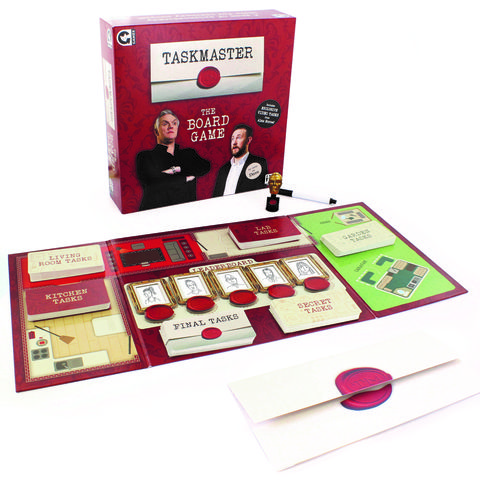
I’ve talked about it before on this blog, but I love Taskmaster. I think it’s a genius format and one of the funniest shows on TV right now. The board game takes what that show is about and adapts it for a homely, low-budget environment, and it really seems to understand the format it’s in. I think that’s worth giving special praise for, too, so many board games based on popular shows don’t really get the format they’re in and just rely on the name-brand to do all of the work, but The Taskmaster Board Game feels like it understands the best way to play Taskmaster in your home.
Firstly, it doesn’t add any frills. It doesn’t create some board that you have to hop around and only do tasks when you land on the right space or something like that; it knows that the tasks are what you’re here for, so it just lets you go with it. Several of the tasks can be transferred over from the show with no problem, while others are adapted to be on a smaller scale, but they’re all still fun to play. On top of that, there’s genuinely loads. While it may get a bit repetitive if you played it too much, there are so many tasks in there (and hundreds more all over the internet) that it’ll be a long time before you run out.
Letting everyone take turns fulfilling the role of Taskmaster was a good idea as it means everyone gets a variety of participating & running the tasks in a single game. I love how the rules specify that the Taskmaster is completely allowed to make dumb or arbitrary decision if they want to. That lack of restrictions not only apes the show, but it gives so many opportunities for laughs between players.
That’s really all this game has to it, having a laugh with friends as you all take turns humiliating yourselves. Which, let’s be honest, is what Taskmaster is all about.
5 – Superfight

So I don’t like Cards Against Humanity. I’m all for the dark humour (even if some of it hasn’t aged so well), I just don’t think there’s all that much fun to be had in assigning pre-written punchlines to pre-written jokes, and once the shock factor of the dark humour wears off, there’s really nothing under there.
Why does this matter? Because Superfight takes what Card Against Humanity does and fixes those problems I mentioned.
Two decks of cards are laid on the table, one with characters from all aspects of pop-culture and another of superpowers that range from your standard stuff like flight/telekinesis to some silly stuff like ‘is killed by water’ or ‘is on a pogo stick’. From here, there are a handful of different ways of playing the game, but the one I’ve most commonly seen (and think is the most fun) is as follows:
One player at the table will be the supervillain. They play a character card & a superpower card from their hand and then draw & play a random superpower from the deck. Each player then takes turns playing one character & one superpower card that they think would beat the supervillain. At this point, the game becomes a debate of ‘who would win in a fight between…?’ but with many ridiculous scenarios like 50 Batmen VS Pikachu inside a giant robotic elephant or whatever.
What makes this so much funnier that something like Cards Against Humanity is that the cards simply act as a launching pad for the players to make their own humour. The debate surrounding exactly how 50 Batmen could disable a giant robotic elephant and then beat up Pikachu always leads to hilarious scenarios, especially when other players argue back. You can make it even funnier by allowing players to play extra superpower cards on other people, potentially crippling an otherwise worthy opponent by making it so that they’re uncontrollably weeping.
Rather than the cards serving as the jokes, it allows the players to be creative and play to their audience. You could never play Cards Against Humanity with your grandparents, but with Superfight, you can just keep it clean. There are other DLC decks that let you tailor the game to your audience, with kid-friendly stuff or R-Rated stuff. It makes it a far more versatile game and is way more hilarious when you’re making original jokes with people you know.
4 – Skull
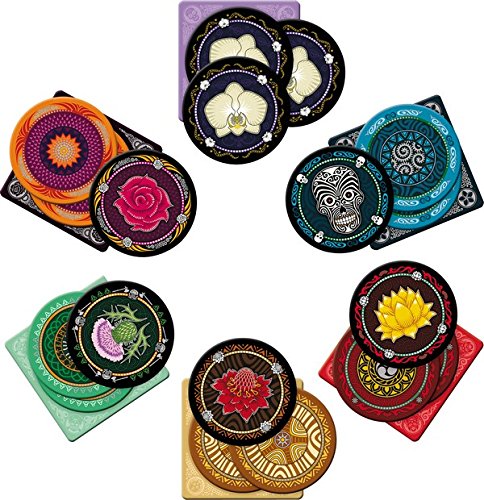
I love traditional playing-card games. Games like Poker and Cribbage have an outstanding balance of playing the odds and reading your opponents to create an endless amount of exciting scenarios that really get the brain whirring. Skull takes the essence of those games, simplifies, beautifies, and repurposes the formula for something that feels so fresh yet so familiar.
In Skull, 3 to 6 players each get 4 cards. 3 of these cards have flowers, and 1 of them has a skull. Each player picks one of these cards to place face-down in front of them, then each player takes their turn. On their turn, a player can either put another card face-down or start the ‘bidding’ process. Here, a player says how many cards they think they can turn over WITHOUT turning over a skull. All of the other players can either raise this bet or pass until only one person has a bet left in play. That player then turns over people’s cards in an attempt to reach their target.
This already gives the game a nice layer of bluffing about who’s cards might be safe, but there’s a small twist that adds so much strategy to the game. This twist is that when you start turning cards, you have to turn over all of your own cards first. This means that if you’ve put a skull down to try and bluff someone or screw someone else over, you’re done for. This means that you have to avoid putting a skull down to win rounds, but doing so also leaves the door open for others to score by turning over your cards.
It’s a simple enough formula that just about anyone can understand, but your thought processes can get so deep as you decide whether or not to put a skull down, or who’s cards you think are safe, or whether it’s time to start betting. It’s the board game that I think best captures the essence of what those play-card games I love are all about.
3 – Muffin Time

Who doesn’t love a bit of chaos? Well, most board-game enthusiasts, it seems, but sod it, I love a game full of random bullshit.
I’ve always had a love for the asdfmovie series on YouTube, and all of Tomska’s work, in fact, so I was on board with the premise of a card game based on the franchise from the very beginning especially one by Big Potato Games. While I haven’t featured many of their games on this list, when it comes to party games, you’d be hard-pressed to find any company with an output of such consistently high quality.
In Muffin Time, you start off with 3 cards, and your goal is to get 10 cards. On your turn, you either draw a card from the deck, lay a trap card, or play an action card. That’s it. It’s an insanely simple game, but what’s on those cards is where the fun comes in. Firstly, there are action cards, which have all sorts of conditions on them. Some start a minigame, like a thumb war or finger guns. Others say things like “steal 3 cards from the tallest player”. Basically, it’ll either benefit/hinder people, based on aspects of them, or it’ll have a fun little minigame.
The real fun stuff comes in the trap cards, though. These are cards that you lay face down on the table and ‘activate’ when someone in the game does a specific action. For example, you could get a trap card that lets you steal 3 cards from someone when they ask what the time is, or when they say a specific phrase, or talk about something from the past. What this means is that everyone on the table is constantly trying to bait each other into doing or saying certain things, and because of that, everyone has their guard up, and everyone is suspicious of everyone at all times. It’s unbelievably fun and incredibly funny when you perform a seemingly ordinary action only for someone to go “AH-HA!” and turn over a card that fucks you over because you said the word “what”.
The nature of it means it works in many different contexts too. You can play it with a group of friends your own age, or you can play it with the family, and it’ll still be a fun experience because it’s so easy to understand and the humour is very simple. It’s one of the rare examples of a game that’s “fun for all the family” that isn’t boring for anyone who’s age has more than one digit.
2 – Cosmic Encounter

There’s so much going on with Cosmic Encounter, and it’s ALL brilliant.
It’s the most rules-heavy game on this list, so I won’t go through all of it, but in short: Each player has some planets they call home and a fleet of spaceships defending them. Players take it in turns attacking each other’s planets to take over as many foreign planets as possible. The system all of this works under is like Risk, but better in just about every way because there’s no random elements, a bunch of potential of poker-style bluffing and a hefty dose of strategy.
This on its own is already a fantastic strategy game, but, as always, there’s a twist. While the game has these very robust rules laid out that have been honed over the game’s VERY long lifespan, each player has their own alien race to play as. These alien races all have their own unique abilities, but it’s not like in other games with player bonuses. The bonuses in this game aren’t just little helping hands that push you down one type of strategy, they’re ridiculously overpowered abilities that totally break one or more of the game’s rules. Now, this does seem a bit unfair (and sometimes it is) until you consider the fact that every player in the game has their own game-breaking power.
These powers can combo up in insane ways to create some mind-bending but hilarious scenarios. For example, one player might have the power to reverse the decision of a battle before the battle takes place, so if they think they’re going to get destroyed, they can turn into a win. However, the player they’re fighting against will WIN THE ENTIRE GAME if all of their ships are destroyed, which means they’re going to be trying to lose the fight. Except, the second player knows what the first player’s power is, so maybe they’re trying to win the battle in the hopes that the first player will reverse the decision? WHAT DOES ANYONE DO?!
That’s just one of a near-infinite amount of ways these powers could combine in games, and all of them have been carefully crafted and honed over many years. It has tonnes of replayability, too, with 51 different aliens in the base game and 196 aliens if you get all of the expansions. No game will have you scratching your head so hard while laughing even harder in a truly masterful blend of chaos and strategy.
1 – Secret Hitler

I said it at the start, and I’ll say it again now, I enjoy lying in games. Social Deduction is inarguably my favourite genre of board game, and while upcoming games like Blood on the Clocktower look very interesting, to date, nothing has beaten Secret Hitler as far as I’m concerned.
At the start of the game, everyone gets given their secret roles. Players are split into two teams, ‘Liberals’ who are the good guys and the ‘Fascists’ who are the bad guys. One player will also be ‘Hitler’, who is on the team of the Fascists (duh). The Fascists know who their allies are, the Liberals do not. Each player takes a turn being the ‘President’, and they must pick one other player to their ‘Chancellor’. They then draw 3 policies, which will either be Liberal or Fascist in nature. The President discards 1 policy and hands the remaining 2 to the Chancellor, who then discards 1 more and plays the remaining policy.
Here, the debate begins depending on which team the policy that was played came down for. Liberals need to enact 5 Liberal policies to win the game, the Fascists need 6, but the deck is weighted in favour of the Fascists, with 11 of the 17 policies in the deck being Fascist. On top of that, the more Fascist policies that get enacted, the more powers get unlocked for players to use. This means that even the Liberal players have an incentive to play Fascists policies, as they can be instrumental in uncovering the Fascists or even getting the ability to kill players, which, if done to Hitler, will win the game for the Liberals.
There are so many interlocking strategies here, but since none of the Liberals know who their allies are, they can communicate a plan to anyone until they trust them; and even when you do trust them, they could just be playing you. As you can imagine, this is a game filled to the brim with lies, betrayals, risks, rewards and failures, and all of it is an absolute blast. This is the game that I have the most fond memories of, as I’ve played it at several different stages in my life, and there’s never been a bad game.
Nothing brings friends together like loudly arguing with each other over who’s Hitler.
And that’s it! Thank you very much for taking the time to read this list, please, let me know what your favourite board games are in the comments below, or let me know on Twitter @SStyleSmark. Finally, make sure to come back here this time next Saturday, where I’ll be covering AEW Revolution!
 The Strong Style Smark